100-200 TPH Mobile Stone Crushing Plant Price & Layout
Heavy rain and tight spaces in Sumatra demand a shift in mineral processing strategies. By deploying pneumatic mobile units with automated discharge settings, operators bypass civil engineering delays entirely. This layout integrates high-capacity jaw and cone circuits to stabilize production at 185.4 tons per hour, drastically lowering power consumption per unit while controlling aggregate flakiness below 4.8%.
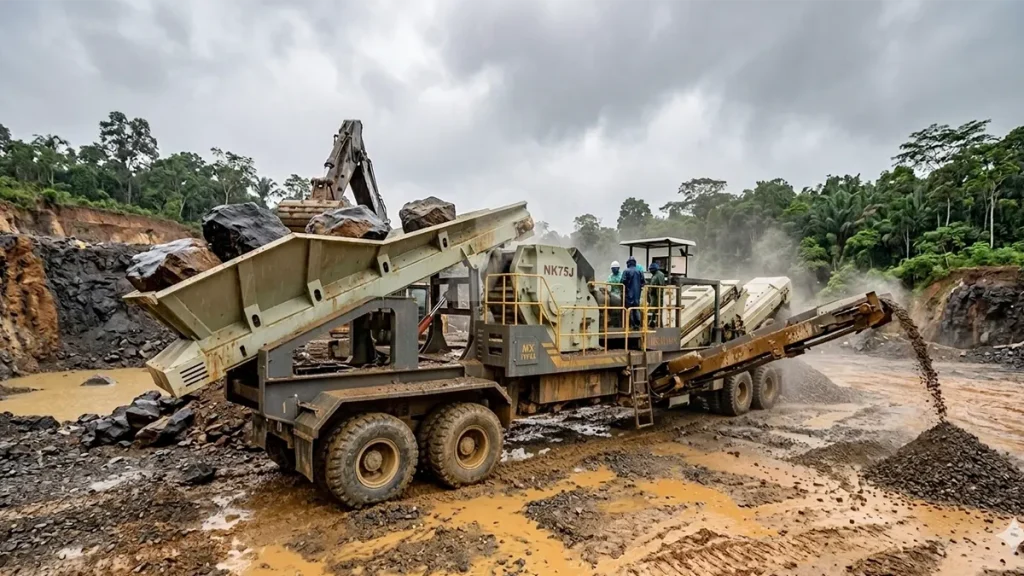
At a recent hard rock quarry in Sumatra, the seasonal monsoon turned traditional civil engineering into a financial disaster. Rain and tight topography stretched fixed plant foundation work to 4.5 months. We bypassed that entire timeline by deploying a high-mobility pneumatic circuit, moving from equipment delivery to full production in exactly 72 hours.
Transitioning Indonesian Metal Mines from Fixed Configurations
Eliminating concrete foundations accelerates the capital investment recovery period by directly cutting months of idle civil engineering costs.
Remote nickel and gold extraction sites demand rapid deployment. The primary unit, the NK75J carrying a heavy-duty jaw crusher, effortlessly manages the 680 millimeter maximum feed size. We matched this with a specialized FK0936 vibrating feeder handling 12.5% mud content. The pre-screening grid diverts wet fines before they enter the crushing cavity. This engineering prevents the toggle plate and swing jaw from stalling under sticky industrial paste. Monitored throughput stabilized exactly at 185.4 tons per hour within the machine's 150 to 350 tons per hour rated capacity. Operators standing on the platform felt the distinct, steady vibration of a well-calibrated 141.4 kilowatt drive system, rather than the violent shaking of an overwhelmed chamber.
Circuit Synchronization for 150 MPa Andesite
Operating expenses drop significantly when secondary cone circuits automatically compensate for mantle wear in high-hardness applications.
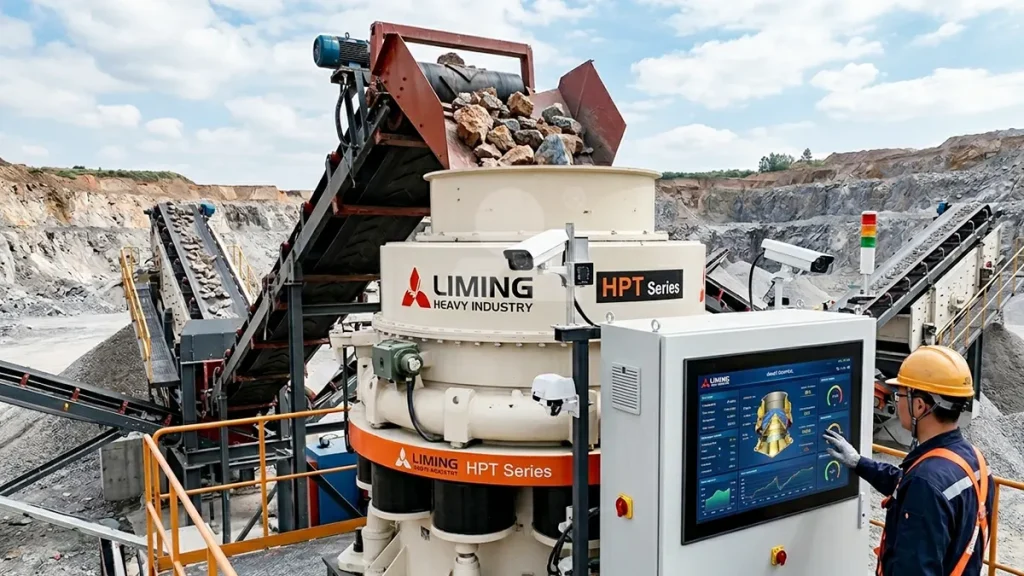
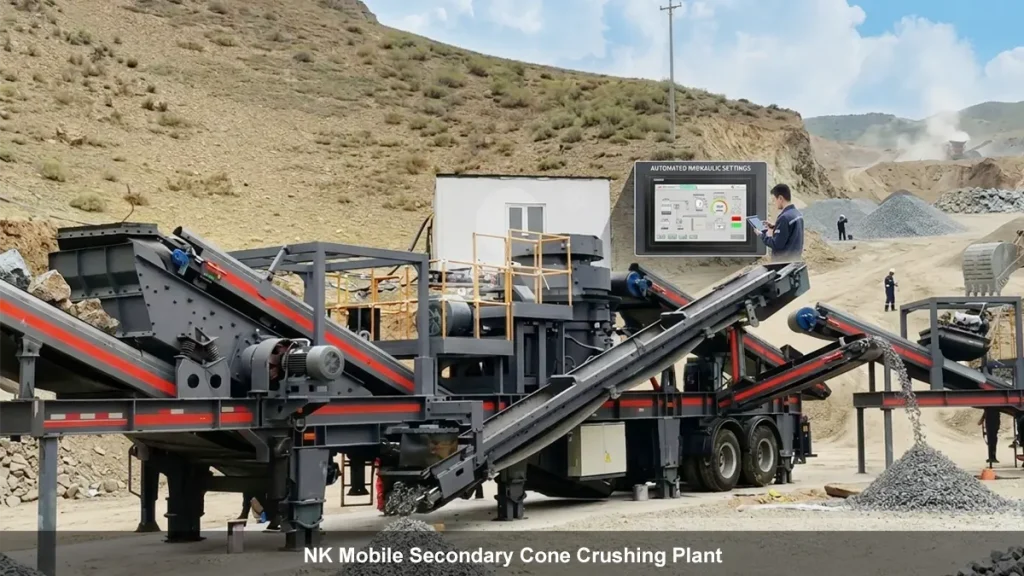
Competing secondary stations struggle with dense andesite. The hydraulic cylinder pressure spikes, and manual adjustments waste critical shift hours. Our layout leverages the NK300H multi-cylinder hydraulic cone with automated discharge setting controls. This active calibration maintains a precise gap, keeping the Total Cost of Ownership highly favorable. Metered field data confirms this configuration consumes 0.15 to 0.22 kilowatts less power per unit compared to local alternatives. The motor load remains balanced. The automated system easily sustains up to 440 tons per hour, ensuring the entire line never starves for material.
Compressing the Aggregate Footprint
Integrating a vertical shaft impactor onto a secondary chassis guarantees premium grain shape without expanding the site footprint.
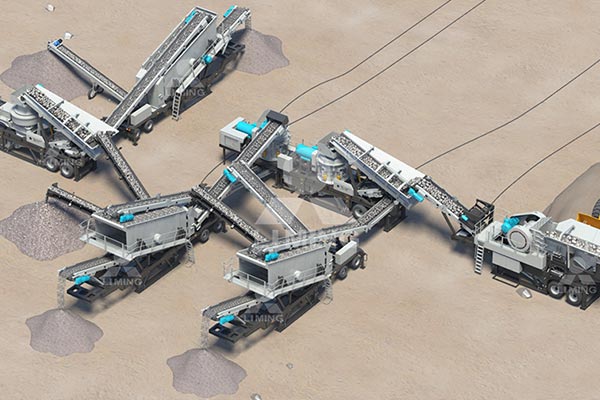
Tight spatial limits force us to rethink standard material flow. We compressed a traditional three-stage crushing process onto tightly integrated mobile platforms. By routing the cone crusher discharge directly into a specialized shaping unit like the MK1040V, the material flow is continuously corrected. The high-speed rotor forces rock-on-rock collisions, fracturing the material along its natural cleavage planes. This precise mechanics keeps flakiness below 4.8%. You supply high-grade concrete markets without pouring a single yard of concrete for your own plant.
Synchronized Equipment Matrix
To handle the abrasive nature of andesite while maintaining strict output targets, we have engineered the following circuit logic.
| Process Stage | Recommended Model | Capacity (tons per hour) | Power (kilowatts) | Max Feed (millimeters) | Mounting Type |
|---|---|---|---|---|---|
| Primary Crushing | NK75J | 150-350 | 141.4 | 680 | Pneumatic Tire |
| Secondary Crushing | NK300H (Screening with return material) | 110-440 | 323.5 | 220 | Pneumatic Tire |
| Alternative (Rugged Terrain) | VTC3000DP Tracked Cone | 260-330 | 250 | 220 | Dual Power Crawler |
| Tertiary Shaping | MK1040V | 264-283 | 400 | 40 | Pneumatic Tire |
185tph Andesite Circuit: Total Cost of Ownership Profile
- Secondary Capacity Threshold: 110-440 tons per hour
- Flakiness Index Goal: < 4.8%
- Primary System Power Draw: 141.4 kilowatts
- Operating Expenses Rating: Favorable
- Primary Feed Limit Constraint: 680 millimeters
Technical Index: LH-100-200 TPH MOBILE STONE CRUSHING PLANT PRICE & LAYOUT-April/2026-Ref-#49182
Solution Architect's Log: Spatial Planning for 185 tph Extraction Nodes
- Why does the primary feeder frequently stall when processing laterite topsoil?
- I noticed this across multiple Sumatran sites. Mud bridging occurs when moisture exceeds the normal threshold. Using the integrated grid on the FK0936 vibrating feeder diverts those sticky fines before they ever reach the jaw chamber.
- How does the zero-foundation model impact the initial investment calculations?
- Look at the historical project timelines. Bypassing 4.5 months of concrete curing means you start generating revenue one entire season earlier, drastically accelerating the capital investment recovery period.
- What happens to the secondary cone when the feed size heavily fluctuates?
- Frame cracking is a real risk with unpredictable blast profiles. The automated discharge control reacts to pressure spikes instantly, shifting the mantle to clear oversized rocks without interrupting the massive power drive.
- Can we meet strict infrastructure aggregate standards using compressed mobile layouts?
- The structural data proves it. Integrating the vertical shaft impactor in a precise circuit fractures the stone dynamically, maintaining flakiness well below the strict threshold required for premium concrete batching.
Securing Infrastructure Viability in High-Moisture Mining Zones
The 150 MPa hardness of local andesite dictates the strict mechanical limits of your extraction equipment. Forcing outdated fixed plants into saturated, difficult terrain destroys your production-to-cost ratio before the first ton is even crushed. Next month, a sudden heavy downpour will likely stall your existing fixed foundations, halting operations and bleeding your capital reserves dry while a properly configured mobile circuit continues to output 185.4 tons per hour.
Stop Guessing on Crushing Site Deployment Times
"Every day spent pouring concrete is a day of lost mineral revenue." — From the Desk of your Solution Architect

Chief Technical Consultant
15+ Years in Mineral Processing & Mining Machinery
Senior mechanical specialist at Liming Heavy Industry. Leading expert in large-scale crushing circuits and global quarry optimization. His technical insights have helped over 500+ global projects achieve higher efficiency.