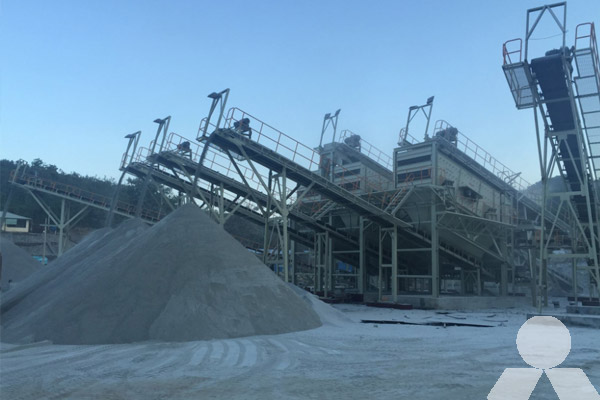
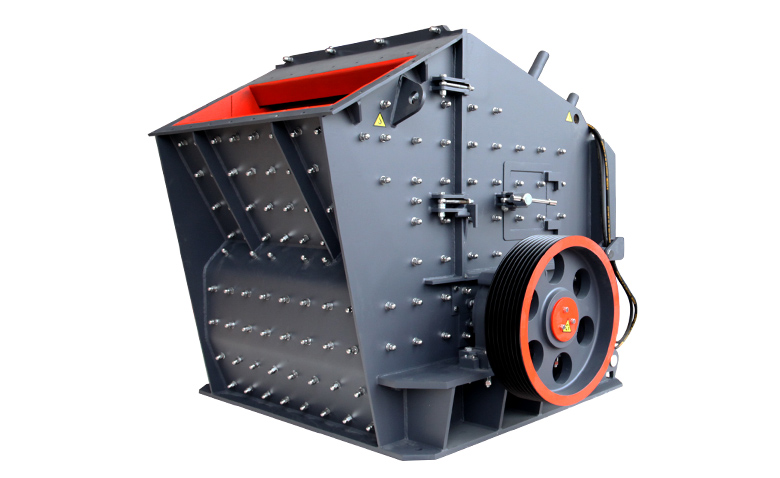
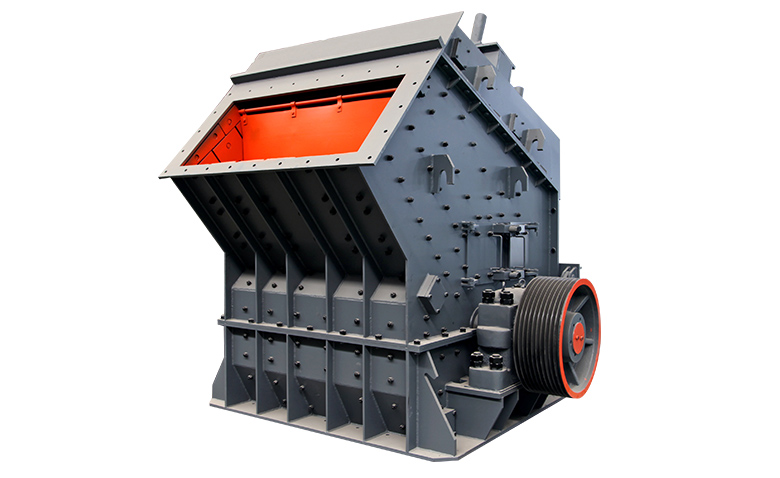
Single Stage Hammer Crusher for Limestone Cement Plant
A Single Stage Hammer Crusher for Limestone Cement Plant fundamentally rewrites volumetric plant architecture. By utilizing a massive 1500 kW rotor to achieve a 50:1 reduction ratio, architects can eliminate the entire secondary crushing circuit. This single kinetic strike reduces 1000mm boulders to a strict 25mm profile, drastically dropping the downstream raw mill's electrical power consumption and accelerating the entire plant's capital payback velocity.
Erasing the Secondary Circuit: Architecture of the Single Stage Hammer Crusher for Limestone Cement Plant
The 50:1 Reduction Architecture: Erasing the Secondary Circuit
Every transfer belt and secondary crusher you install introduces a new point of mechanical failure. Erase them.
The traditional approach to limestone processing requires a primary jaw crusher followed by a secondary impactor or cone. This demands massive physical footprints, miles of conveyor belting, and multiple dust collection nodes. The single-stage heavy hammer crusher disintegrates this legacy architecture. Utilizing a massive high-inertia rotor, it absorbs 1000mm run-of-mine limestone and reduces it to 90% passing 25mm in a single kinetic strike.
This immense 50:1 reduction ratio is achieved through the sheer kinetic mass of the hammerheads colliding with the rock, followed by secondary shearing against the impact plates. By eliminating the secondary crushing circuit entirely, plant architects drastically lower the initial hardware price and cut the required concrete foundation footprint by over 40%.
Grate Geometry and Raw Mill Synergy
The true value of a crushing circuit is measured by the electrical draw of the downstream raw mill. The "crush more, grind less" philosophy dictates that it is mathematically cheaper to shatter rock with kinetic impact than it is to grind it via attrition in a vertical roller mill or ball mill.
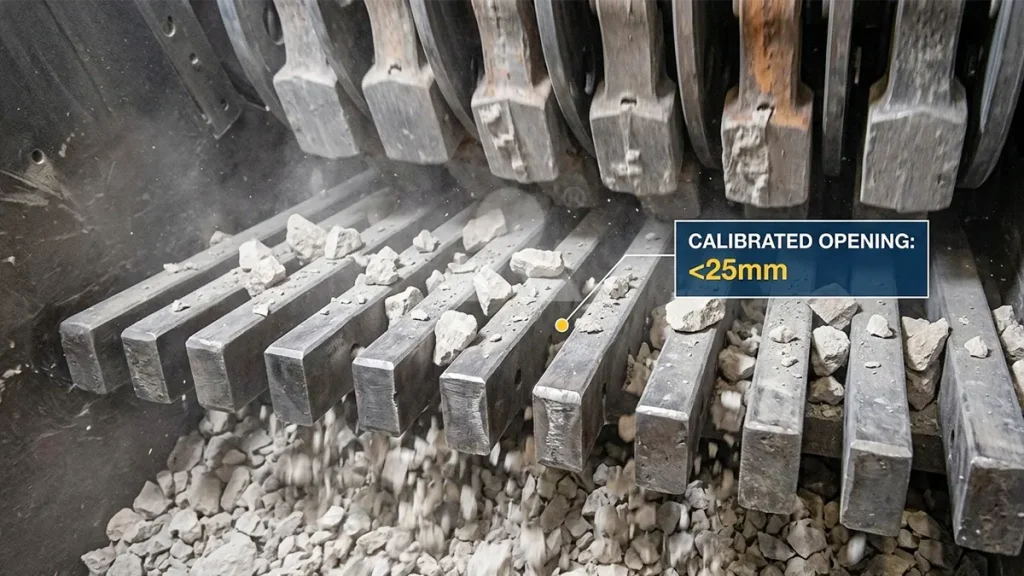
The single-stage hammer crusher enforces a strict <25mm discharge through meticulously calibrated grate gap geometry at the bottom of the chamber. If the rock is too large, the rotor carries it back around for another kinetic strike. This physical gatekeeping drops the downstream raw mill's electrical power consumption by up to 22%. You are transferring the workload from the most expensive machine in the plant to the most kinetically efficient one.
Synchronized Equipment Matrix for Cement Feed
A single-stage crusher requires immense volumetric surge protection. If the feed fluctuates, the rotor starves or chokes.
| Process Stage | Recommended Architecture | Capacity (tph) | Power (kW) | Architectural Function |
|---|---|---|---|---|
| Surge Feed Control | Heavy-Duty Apron Feeder | 800-1500 | 45 | Absorbing dump-truck kinetic shock |
| Single Stage Crushing | PCZ Heavy Hammer Crusher | 500-1500 | 1500 | 1000mm to 25mm direct reduction |
| Buffer Storage | Circular Limestone Stacker | 1500 | -- | Homogenizing silica/calcium grades |
| Raw Grinding | Vertical Roller Mill (VRM) | 300-600 | 3000+ | Pulverizing 25mm to 90-micron raw meal |
Notice the Heavy-Duty Apron Feeder. You cannot use a standard vibrating feeder for 1000mm boulders dropping from a 60-ton haul truck. The apron feeder acts as the ultimate shock absorber, providing a continuous, unbreakable ribbon of limestone to the 1500 kW rotor.
1500kW Limestone Circuit: Kinetic & Volumetric Thresholds
- Reduction Ratio Limit: Strictly 50:1 per kinetic strike
- Main Rotor Power Draw: 1500 kW (requires high-voltage soft start)
- Moisture Blinding Threshold: >8% clay forces grate-gap recalibration
- Raw Mill Energy Reduction: 18-22% drop verified under <25mm feed
- Limestone Hardness Limit: < 150 MPa (Excessive silica shatters hammers)
Technical Index: LH-SINGLE STAGE HAMMER CRUSHER FOR LIMESTONE CEMENT PLANT-OCT/2026-Ref-#48192
Moisture Blinding and High-Inertia Rotor Kinematics
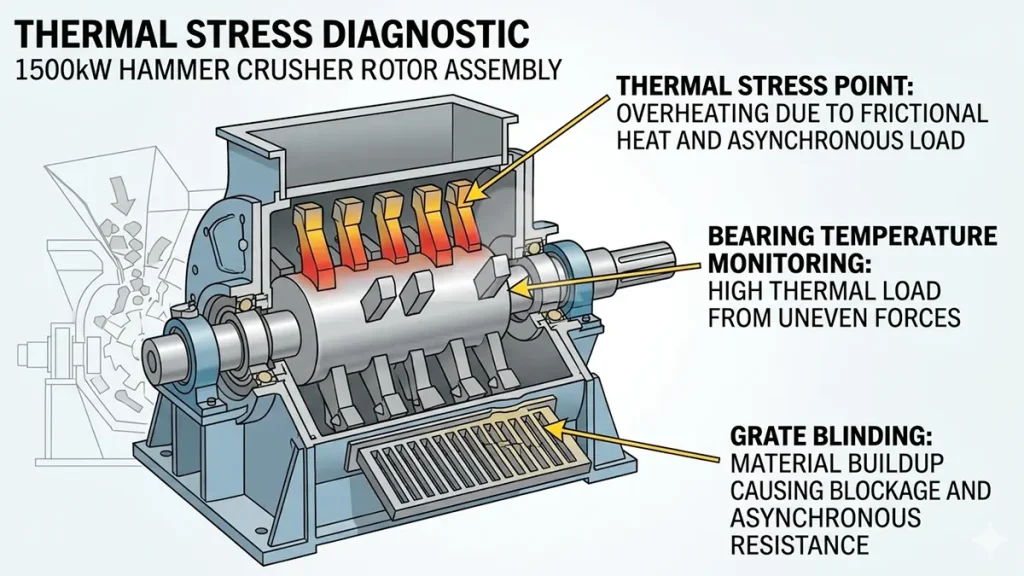
Limestone in a quarry is rarely pure; it is often laced with topsoil, clay, and trapped moisture. When limestone moisture exceeds 8%, the clay content turns into an industrial paste inside the crushing chamber. If the architecture utilizes a narrow grate gap to force a fine output, this wet paste will blind the lower discharge grates entirely.
Field Note: The vibration is unmistakable. When the grates blind, the rock cannot escape. The 1500 kW rotor begins dragging through a packed bed of solidifying limestone, sending massive asymmetrical shockwaves through the foundations. You can feel it in the control room floor.
Grate Geometry Diagnostics & Raw Mill Starvation Post-Mortem
I inspected a Vertical Roller Mill last month that was vibrating so violently it was tripping the high-voltage breakers. The root cause was the hammer crusher passing +50mm slabs because a section of the discharge grate had broken off. The VRM rollers were attempting to crush boulders instead of grinding 25mm gravel.
If the limestone exceeds 150 MPa or contains high abrasive silica, the kinetic impact vaporizes standard manganese hammerheads in days. Today, utilizing bi-metallic high-chrome alloy hammers allows the single-stage architecture to survive abrasive zones without bleeding expenditure per shift.
Do not rely on human operators to regulate a 1500 kW machine. If the apron feeder pushes too much 1000mm rock simultaneously, the rotor velocity drops, and the kinetic shearing force collapses. An automated PLC loop must instantly slow the feeder when the rotor amps spike, preventing a catastrophic chamber stall.
Calculating the electrical infrastructure reveals the truth. A secondary impactor requires its own massive motor, switchgear, dust collector, and two additional conveyor belts. Deleting all of this hardware from the flow chart slashes the initial hardware price by millions and permanently lowers the daily mechanical maintenance overhead.
Enforce the 25mm Boundary to Protect Your Raw Mill
A cement plant operates as a unified thermodynamic engine; the crushing stage cannot be divorced from the grinding stage. If your Single Stage Hammer Crusher for Limestone Cement Plant is failing to enforce a strict 25mm discharge geometry, you are actively sabotaging your Vertical Roller Mill. Next month, continuing to feed oversized, moisture-packed slabs into your grinding circuit will fracture your mill rollers and completely paralyze your clinker production timeline. Erase your secondary circuits, calibrate your grate geometry, and enforce raw mill efficiency.
Arrest Raw Mill Starvation and Calibrate Rotor Kinematics
"What is the exact percentage of +25mm rock entering your raw mill right now? Send us your limestone silica content, and let's architect a single-stage volumetric flow." — From the Desk of your The Solution Architect
Architect Your Cement Circuit
Chief Technical Consultant
15+ Years in Mineral Processing & Mining Machinery
Senior mechanical specialist at Liming Heavy Industry. Leading expert in large-scale crushing circuits and global quarry optimization. His technical insights have helped over 500+ global projects achieve higher efficiency.