Primary Gyratory Crusher vs Jaw Crusher for Large Mining
Designing a 2500 tph extraction circuit is an unforgiving exercise in mass flow architecture. Attempting to match the continuous 360-degree annular compression of a single HGT5065 gyratory with three parallel C6X jaws triples the electrical nodes and demands 15 extra meters of horizontal vibrating feeders. However, deep-shaft gyratory foundations fail in high-water-table geologies, mandating a strategic pivot to surface-level jaw installations.
Deconstructing 2500tph Spatial Nodes in Primary Gyratory Crusher vs Jaw Crusher for Large Mining
Continuous Mass Flow vs. Intermittent Compression
A jaw crusher's empty return stroke is a 50% loss of kinetic opportunity.
I constantly review massive 3000 tph flowcharts drawn by amateurs who do not understand crushing physics. A jaw crusher operates on intermittent compression. As the pitman pulls back, 50% of its mechanical stroke is an empty return phase. It is waiting for gravity to drop the rock. The HGT gyratory operates on continuous annular compression, crushing rock across 360 degrees without a dead phase.
This continuous action neutralizes kinetic surge spikes.
When you engineer a primary station, you are managing the violence of raw blast rock. The gyratory's constant rotation allows it to swallow material without the violent power spikes inherent to a jaw's crushing cycle. This drastically smooths the downstream mass balance, ensuring the secondary cone crushers receive a uniform feed rather than violent, pulsating surges.
Direct Dumping Geometry and Spatial Footprint
A primary extraction station is an intersection of mine haulage and processing geometry. A gyratory crusher dominates spatial mass flow because it is engineered to accept two-sided direct dumping from 100-ton mining trucks. There is no buffer. The trucks back up to the rim and drop their payload directly into the crushing chamber. A jaw crusher physically cannot survive direct dumping.
Dumping 100 tons directly onto a jaw's pitman will shatter the toggle plate instantly.
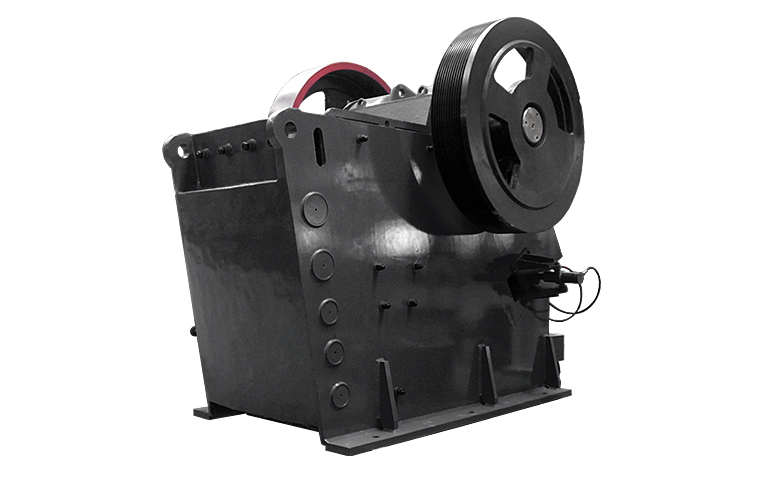
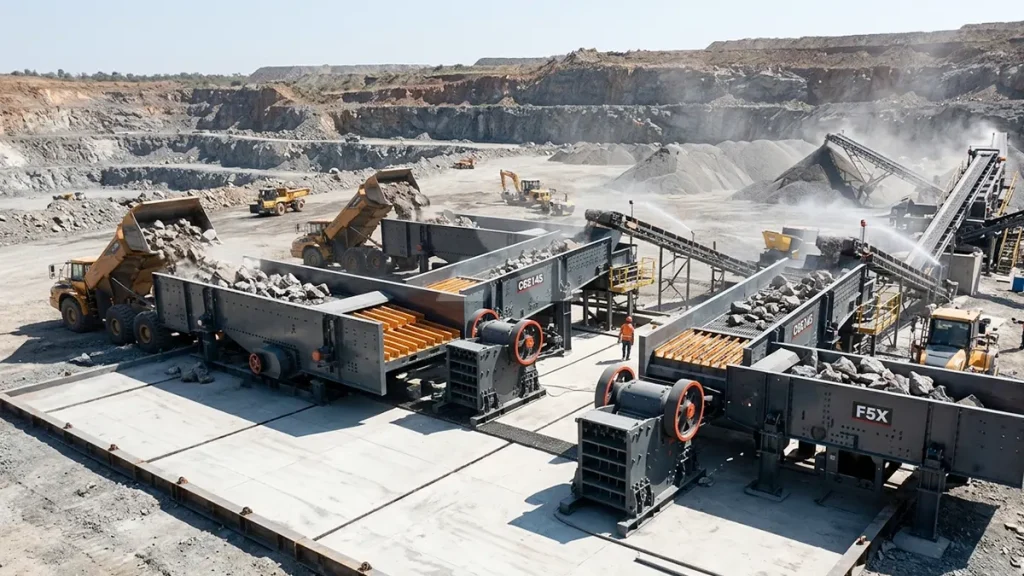
To safely feed a jaw crusher, you must install an active heavy-duty vibrating feeder (like the F5X Series) to meter the rock. This mandatory integration extends the primary station's horizontal footprint by over 15 meters. If you are forced to parallel three C6X145 jaws to match the 2500 tph output of one HGT5065, you are not just buying three crushers; you are excavating three massive concrete ramps and installing three separate F5X feeders.
Architecting a 2500 tph extraction node requires selecting between vertical depth and horizontal sprawl.
| Architectural Variable | HGT5065 Gyratory Configuration | Parallel C6X145 Jaw Configuration | Mass Balance Impact |
|---|---|---|---|
| Target Capacity (tph) | 2400-2940 (Single Unit) | 2850 (3x 950 tph maximum) | Identical Output |
| Feeding Mechanism | Direct Truck Dump (Zero Feeder) | 3x F5X1860H Vibrating Feeders | High horizontal sprawl |
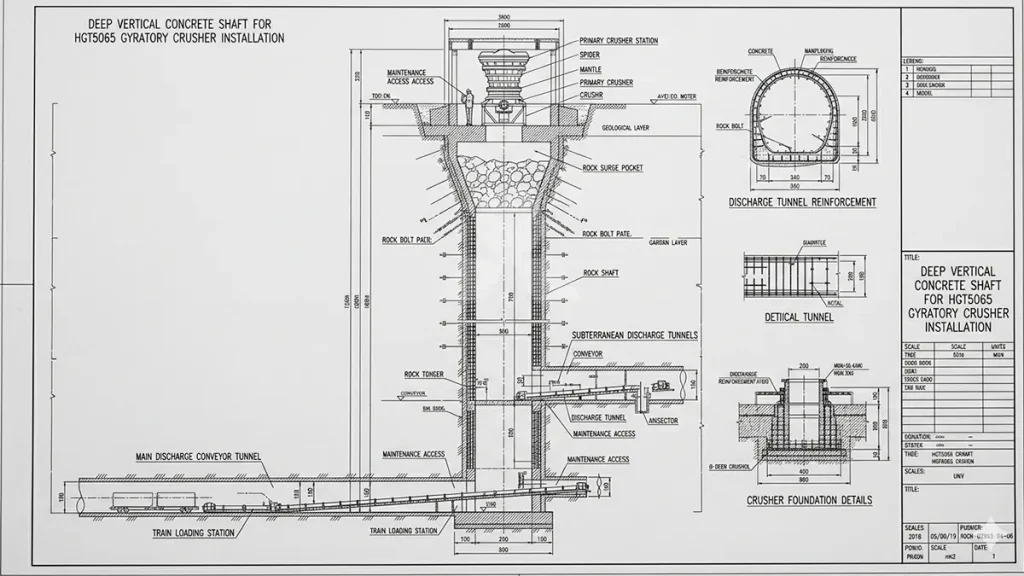
| Civil Engineering Footprint | 20m Vertical Concrete Shaft | Massive Surface Pad & Retaining Walls | Geology Dependent |
Analyze the civil engineering footprint. The jaw configuration spreads out across the surface, demanding extensive horizontal retaining walls to support the dump truck ramps. The HGT5065 buries itself vertically, centralizing the flow but demanding extreme geological stability.
2500tph Hard Rock Extraction: Spatial Constraint Audit
- Sustained Node Flow: 2450-2600 tph continuous extraction
- Gyratory Power Draw: 400 kW (Single HGT5065)
- Parallel Jaw Power Draw: 600 kW (3x 200 kW C6X145)
- Max Feed Integration: 1270 mm directly from 100-ton haulers
- Primary Discharge Belt: Requires 1400mm width (B-Series)
LH-PRIMARY_GYRATORY_CRUSHER_VS_JAW_CRUSHER_FOR_LARGE_MINING-April/2026-Ref-#91842
Geological Defenses and Deep-Shaft Excavation
A master architect does not just design machinery; they design around the bedrock. Excavating the foundation for a 400-ton HGT Gyratory requires a massive 20-meter vertical concrete shaft. You are sinking the machine into the earth to accommodate the gravity flow and the subterranean discharge conveyor.
Field Note: I halted a massive copper project in Chile because the EPC firm ignored the hydrology report. Attempting to sink a 20-meter gyratory shaft into a high water table is an invitation to catastrophic flooding.
If the geological survey reveals a high water table or unstable, fractured bedrock, burying a gyratory crusher is financial suicide. In these strictly defined geological constraints, the architectural pivot to a dual-jaw C6X surface installation becomes a mandatory defensive perimeter. The horizontal sprawl of the jaw crushers avoids deep excavation, protecting the infrastructure amortization cycle from endless dewatering expenditures.
Enforcing Architectural Discipline on the Primary Node
Choosing between an HGT Gyratory and a C6X Jaw matrix is not a preference; it is a rigid architectural mandate governed by mass flow and bedrock hydrology. If your geology supports a 20-meter shaft, the single HGT5065 will dominate the 2500 tph extraction rate, eliminating horizontal sprawl and continuous feeder maintenance. If you force a deep-shaft gyratory into a high water table next month, catastrophic flooding and endless dewatering costs will permanently paralyze your capital payback velocity.
Audit your bedrock core samples before finalizing the mass flow architecture.
Align your primary extraction node with geological reality.
"What is the exact depth of the water table at your proposed primary station coordinates? Send me the core data, and let's calculate your excavation viability." — From the Desk of your Solution Architect
STABILIZING INFRASTRUCTURE AMORTIZATION
Chief Technical Consultant
15+ Years in Mineral Processing & Mining Machinery
Senior mechanical specialist at Liming Heavy Industry. Leading expert in large-scale crushing circuits and global quarry optimization. His technical insights have helped over 500+ global projects achieve higher efficiency.