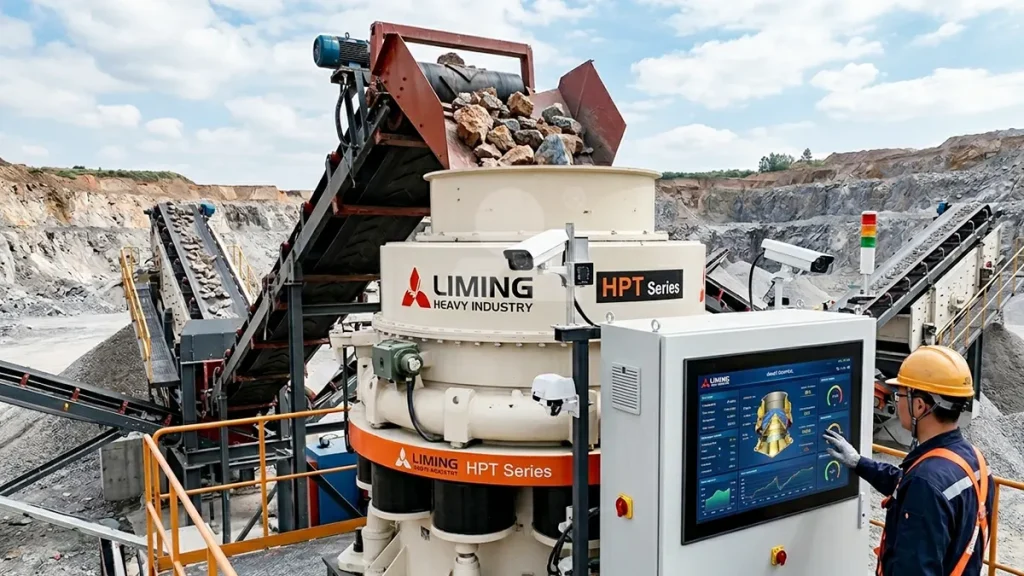
Hydraulic Cone Crusher Capacity and Technical Specifications: A Complete Buyer’s Guide
This comprehensive guide breaks down hydraulic cone crusher capacities and technical specifications, helping quarry operators select the optimal equipment. It explores key performance determinants like Closed Side Setting (CSS), material hardness, and eccentric throw, while comparing single-cylinder (HST) and multi-cylinder (HPT) models. Supported by a real-world 250-300 TPH granite production case study, this article provides actionable engineering insights for maximizing aggregate plant efficiency and reducing wear costs.
Introduction
In heavy-duty mining and aggregate production, selecting the wrong crusher parameters is a costly mistake that directly degrades a plant's profitability. Operating with mismatched technical specifications inevitably leads to severe production bottlenecks, insufficient throughput, and excessive, rapid wear on critical components like mantles and bowl liners. To eliminate these inefficiencies, operations rely on the hydraulic cone crusher—an advanced, high-performance machine that utilizes automated hydraulic pressure to crush hard rock, serving as the indispensable backbone of secondary and tertiary crushing stages.
What Determines Hydraulic Cone Crusher Capacity?
When browsing a technical specification sheet, it is vital to understand that the listed Theoretical Capacity represents an ideal laboratory baseline—not a guaranteed real-world output. In actual mining and aggregate operations, your Actual Capacity (measured in t/h) is a dynamic variable heavily influenced by your specific site conditions.
To optimize your production line, you must manage these three critical determinants:
- Material Hardness & Moisture: The physical characteristics of your feed rock dictate processing time. For instance, crushing highly abrasive granite demands significantly more energy and retention time inside the crushing cavity than processing softer limestone. Additionally, high moisture content causes sticky fines to accumulate, clogging the chamber and dragging down hourly throughput.
- Closed Side Setting (CSS): The CSS is arguably the most vital parameter under your control. It directly determines both your final product size and overall output. A smaller CSS yields a finer end product but restricts material flow, which inherently lowers the t/h capacity. Achieving the perfect balance requires matching your CSS with the optimal eccentric speed to maximize particle-on-particle crushing efficiency.
- Feeding Size & Method: To reach the upper limits of your crusher's rated capacity, maintaining a consistent choke feeding method is non-negotiable. If the feed is uneven or the cavity is underfilled, the rock will bounce rather than crush, leading to poor cubical particle shape, reduced capacity, and accelerated, uneven wear on the liners.
Understanding Key Technical Specifications
When reviewing a manufacturer's brochure, a wall of data and numbers can quickly become overwhelming. However, evaluating a hydraulic cone crusher doesn't require a Ph.D. in mechanical engineering—you just need to know which metrics actually dictate on-site performance. Here is how to decode the most critical specifications on your data sheet:
Motor Power (kW) & Efficiency
The motor power (measured in kW) is the beating heart of your crusher. It doesn't just dictate energy consumption; it represents the machine's brute strength and its ability to process extremely hard or abrasive rock. If you are crushing tough materials like basalt, quartzite, or river pebbles, a robust motor ensures the crusher maintains its operational speed and crushing force even under heavy load, preventing stalling and maximizing mechanical efficiency.
Feed Opening vs. Discharge Opening (CSS/OSS)
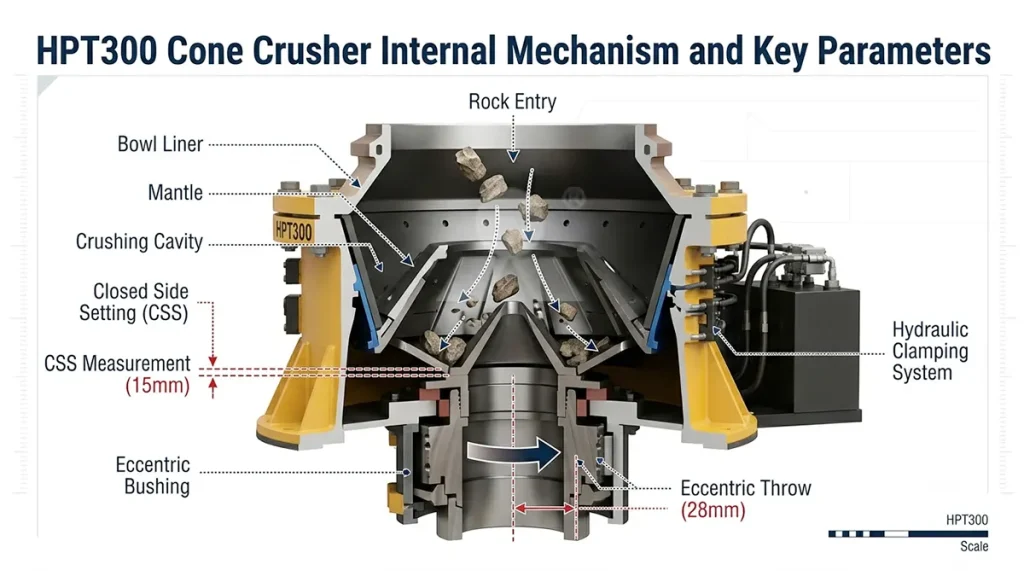
These parameters establish the physical boundaries of your production. The feed opening dictates the maximum lump size the crushing chamber can safely accept—feed rocks that exceed this limit will cause bridging and blockages. On the output end, you must understand the dynamic between the Closed Side Setting (CSS) and the Open Side Setting (OSS). While the CSS controls your final target product size and dictates the narrowest point of the discharge gap, the OSS represents the widest point. Modern hydraulic systems use this gap dynamic to automatically clear uncrushable materials (like tramp iron) without stopping the machine.
Eccentric Throw
Often overlooked by buyers, the eccentric throw (or stroke) is the distance the main shaft swings during each rotation. This metric is the secret weapon for controlling your crushing ratio. A larger eccentric throw takes a bigger "bite" out of the rock, increasing volumetric capacity and making it ideal for high-yield secondary crushing. Conversely, a smaller throw delivers more impacts per cycle, producing the fine, well-shaped cubical aggregates required in tertiary or sand-making stages.
Standard Technical Specification Table
For buyers comparing different models, a structured technical specification table is essential. It helps engineers, quarry operators, and procurement managers quickly evaluate machine performance, processing capacity, and operational requirements.
Below is a sample HST hydraulic cone crusher specification table commonly used in mining and aggregate crushing applications.
| Model | Crushing Capacity (t/h) | Max Feeding Size (mm) | Discharge Opening (mm) | Motor Power (kW) | Weight (t) |
|---|---|---|---|---|---|
| HST100 | 85-170 | 160 | 9-22 | 90 | 10.5 |
| HST160 | 130-275 | 240 | 13-38 | 160 | 13.5 |
| HST250 | 200-450 | 290 | 16-45 | 250 | 18.7 |
| HST315 | 280-650 | 350 | 19-51 | 315 | 24.8 |
| HST560 | 450-1200 | 450 | 22-64 | 560 | 36.5 |
Key Technical Parameters Explained
- Crushing Capacity: Indicates the amount of material the hydraulic cone crusher can process per hour under normal working conditions.
- Max Feeding Size: Refers to the largest material size allowed into the crushing chamber.
- Discharge Opening: Determines the final output size and affects production efficiency.
- Motor Power: Higher motor power generally supports greater crushing force and capacity.
- Machine Weight: Affects transportation, installation, and foundation requirements.
At Liming Heavy Industry, hydraulic cone crushers are designed for high efficiency, intelligent hydraulic control, and stable operation in hard rock crushing applications such as granite, basalt, iron ore, and river stone processing. Different models can be customized according to customer production requirements and final product specifications.
How to Choose the Right Capacity for Your Production Line?
Selecting the optimal crusher is about more than just matching a number on a brochure to your daily quota. It requires aligning the machine's "sweet spot" with your overall plant objectives—whether you are configuring a standard mineral processing circuit or preparing high-quality feed for an Artificial Sand (VSI Sand Maker) plant. To ensure long-term profitability, you must factor in operational headroom and material characteristics.
Here is a practical framework for making the right choice:
The 200 t/h Rule of Thumb
If your goal is a steady, reliable 200 t/h Aggregate Production Line, you should never select a machine where 200 t/h is the absolute maximum limit. Real-world variables like tool wear and feed fluctuation will inevitably drag your average down. Instead, look at a model like the HPT200. With a rated capacity of 90 to 320 t/h, operating the HPT200 comfortably in the middle of its capability range ensures stable, uninterrupted throughput. This built-in buffer prevents motor overload, accommodates sudden surges in feed size, and ultimately extends the lifespan of your wear parts.
Single-Cylinder vs. Multi-Cylinder: Which Wins?
Choosing between our core hydraulic designs comes down to your specific material hardness and placement in the crushing circuit:
- Single-Cylinder Hydraulic Cone Crusher (HST Series): This design is the king of smart automation and massive throughput. Because the main shaft is supported at both ends and the hydraulic adjustment is straightforward, it excels in high-capacity secondary crushing. It is highly responsive to automated feed controls and incredibly easy to maintain, making it ideal for processing medium-to-hard ores at a massive scale.
- Multi-Cylinder Hydraulic Cone Crusher (HPT Series): Engineered for brute force, the multi-cylinder design provides a higher crushing frequency and immense crushing force. This makes it superior for processing extremely hard or abrasive materials, such as granite, basalt, or river pebbles. It utilizes the laminated crushing principle (particle-on-particle crushing) much more effectively, yielding an excellent cubical shape and a high percentage of fine products. It is the perfect choice for tertiary crushing or as a direct feeder into an Artificial Sand (VSI Sand Maker) setup.
Case Study: How HPT300 Multi-Cylinder Hydraulic Cone Crusher Achieved 250-300 TPH in a Granite Production Line
Project Profile
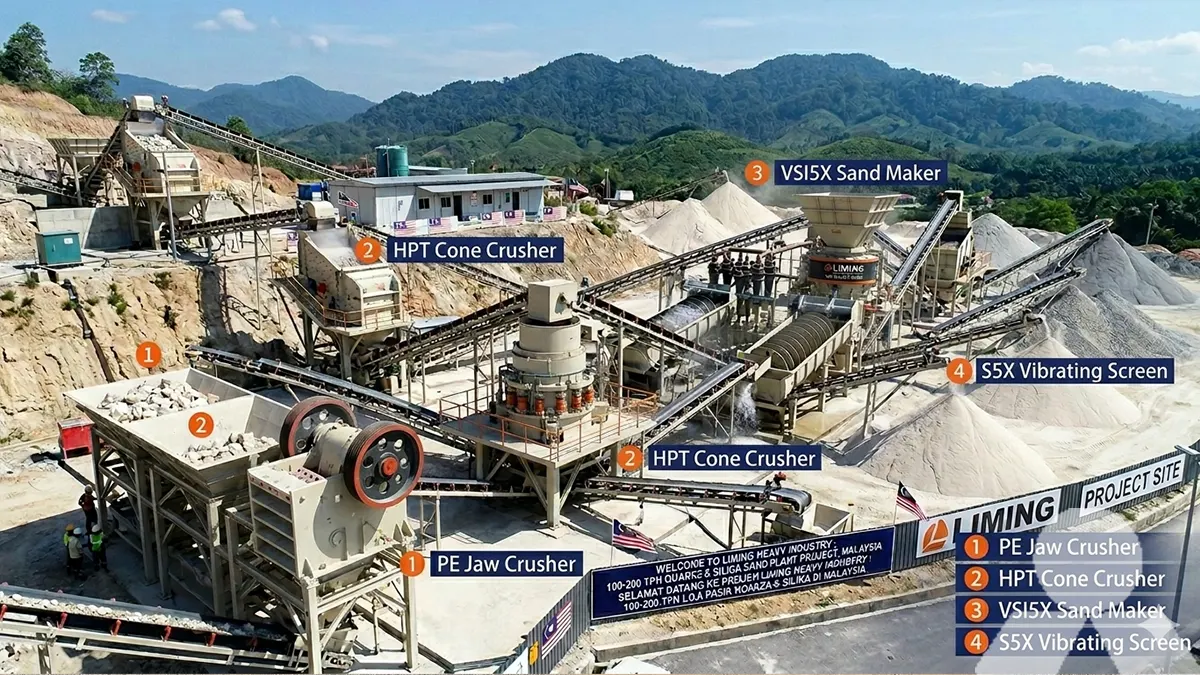
- Location: Malaysia
- Raw Material: Highly Abrasive Hard Granite (Mohs Hardness: 7)
- Max Feed Size: < 220 mm
- Output Sizes: 0-5 mm, 5-10 mm, 10-20 mm, 20-30 mm (High-quality concrete aggregates)
- Target Capacity: 250 - 300 Tons Per Hour (TPH)
The Challenge: High Abrasion and Strict Shape Requirements
A local quarry operator needed to process hard, highly abrasive granite to supply high-grade aggregate for a domestic highway project. The client’s previous crushing equipment struggled with the stone's extreme hardness, leading to frequent downtime for wear parts replacement.
Furthermore, the old system produced a high percentage of elongated and flaky particles (needle-like shapes), which failed to meet the strict cubic shape standards required for high-strength concrete. They needed a secondary/tertiary crusher that could balance a high TPH capacity with low operational costs and premium product shaping.
Our Solution: Optimizing the HPT300 Technical Specifications
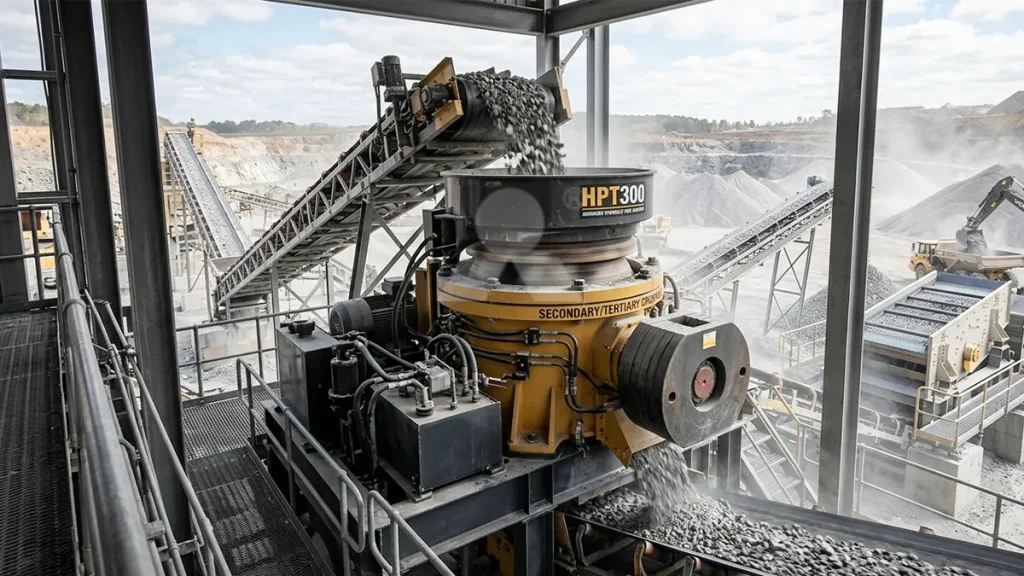
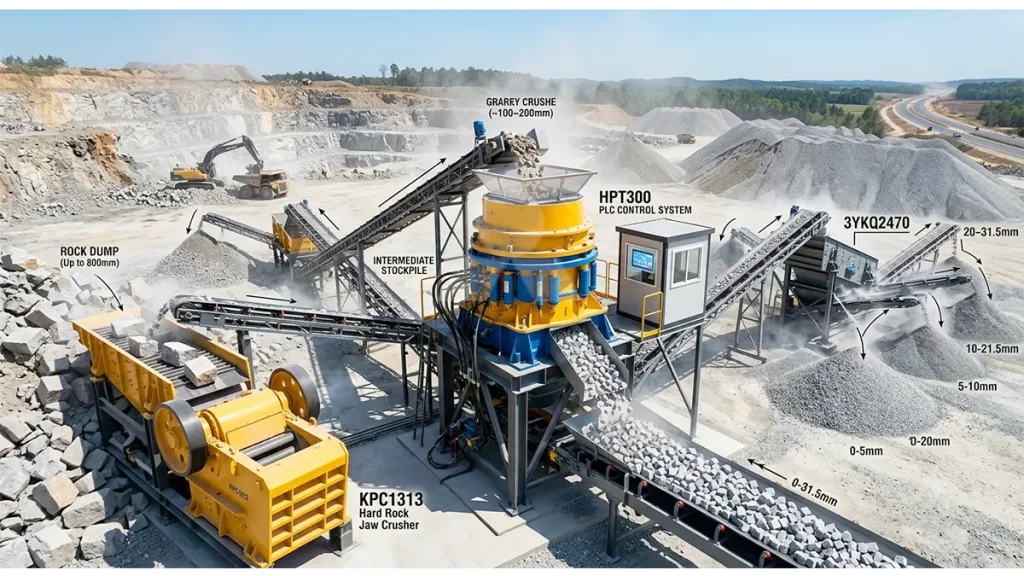
After analyzing the material property and production requirements, our engineering team integrated the HPT300 Multi-Cylinder Hydraulic Cone Crusher into the secondary crushing stage, positioned right after a primary jaw crusher.
- Cavity Selection: We configured the HPT300 with a Medium (M) cavity to safely accommodate the maximum feeding size of around 200 mm while maximizing the throughput.
- Parameter Adjustment: The Closed Side Setting was optimized at 18-22 mm, and the motor power was stabilized at 220 kW to ensure the machine operated at its peak crushing efficiency zone.
The Result: Enhanced Efficiency and Superior Aggregate Quality
The HPT300 cone crusher transformed the quarry’s profitability from day one:
- Stable and High Capacity: The plant achieved a consistent actual capacity of 270-290 TPH, perfectly hitting the upper tier of the HPT300 technical specifications for hard rock.
- Premium Cubic Shape: Utilizing the advanced lamination crushing principle (inter-particle crushing), the HPT300 significantly improved the grain shape. The flakiness and elongation index dropped below 9%, completely satisfying the highway project's standards.
- 60% Reduction in Maintenance Downtime: Thanks to the hydraulic chamber-clearing and automatic overload protection systems, iron tramps were cleared instantly without manual labor, maximizing the equipment uptime. The manganese mantle and bowl liner life expectancy was also extended by 35% due to the optimized crushing chamber design.
Frequently Asked Questions
To help you quickly troubleshoot operational hurdles and optimize your plant, we have answered the most common questions international buyers search for on Google regarding hydraulic cone crusher performance:
What is the main difference between single-cylinder and multi-cylinder cone crushers?
The primary difference lies in their structural design, crushing force, and ideal application. Single-cylinder hydraulic cone crushers (like our HST Series) feature a simpler mechanical layout, offer massive throughput, and excel in secondary crushing stages due to their large feed openings and easy automated adjustments. Multi-cylinder hydraulic cone crushers (like our HPT Series) generate much higher crushing forces and rotational speeds, making them the superior choice for crushing extremely hard rock in tertiary stages where a perfect cubical shape is required.
How can I increase my hydraulic cone crusher’s actual capacity?
To maximize your hourly t/h throughput, you must maintain a consistent choke feeding method so the crushing cavity remains completely full. Additionally, always pre-screen your feed material to remove fines and moisture before it enters the chamber; this prevents packing and clogging, allowing the machine to operate at its peak mechanical efficiency.
How does the Closed Side Setting (CSS) affect a cone crusher's output?
The CSS directly dictates both your final aggregate size and your overall production capacity. A smaller CSS reduces the discharge gap to produce a finer end-product, but it inherently restricts material flow and lowers the total t/h output while increasing liner wear. Widening the CSS increases volumetric capacity but results in a coarser output product.
Which cone crusher type is best for abrasive rocks like basalt or granite?
For highly abrasive or extremely hard rock, a high-efficiency multi-cylinder hydraulic cone crusher is the industry benchmark. The multi-cylinder design utilizes a specialized stroke and high-speed compression to force particle-on-particle crushing (laminated crushing). This technical approach ensures that the rocks crush each other rather than grinding directly against your mantles, significantly extending the lifespan of your wear parts.
Upgrade Your Production with Liming Heavy Industry
Choosing the right hydraulic cone crusher is about more than just reading a spec sheet; it is about partnering with a manufacturer that understands the nuances of your raw materials and end-product goals. Whether you are upgrading a mineral plant, setting up a general aggregate production line, or investing in high-quality Artificial Sand (VSI Sand Maker) solutions, Liming Heavy Industry delivers unmatched reliability.
If you are looking to minimize downtime and maximize yield, our Cone Crusher offers an integrated mechanical, hydraulic, and electrical control system that automatically adapts to fluctuating feed conditions. Ready to optimize your crushing circuit? Contact our engineering team today for a customized capacity analysis and structural recommendation tailored to your project.

Chief Technical Consultant
15+ Years in Mineral Processing & Mining Machinery
Senior mechanical specialist at Liming Heavy Industry. Leading expert in large-scale crushing circuits and global quarry optimization. His technical insights have helped over 500+ global projects achieve higher efficiency.