300-500 TPH Granite Crushing Plant In Zimbabwe
This high-capacity granite circuit for Zimbabwe utilizes C6X series primary jaw crushers and HPT multi-cylinder cone crushers to manage high Mohs hardness. The solution focuses on maximizing system availability and optimizing grading curves for 3/4", 1/2", and 1/4" aggregates through inter-particle crushing and advanced S5X screening.
Based on our engineers tracking wear patterns across high-silica geological zones in southern Africa, the primary threat to continuous throughput isn't the initial equipment price, but the hidden expenditure per shift caused by multi-stage material segregation. Hard granite operations frequently suffer from imbalanced secondary stages, resulting in elevated single-ton wear part costs and an excessive percentage of flaky aggregates. Designing a resilient 300-500 tons per hour infrastructure requires absolute synchronization between cavity geometry and screening architecture.
Arresting Material Segregation in the Primary Stage
Heavy rotor dynamics within the primary phase dictate the mechanical survival of the entire downstream circuit.
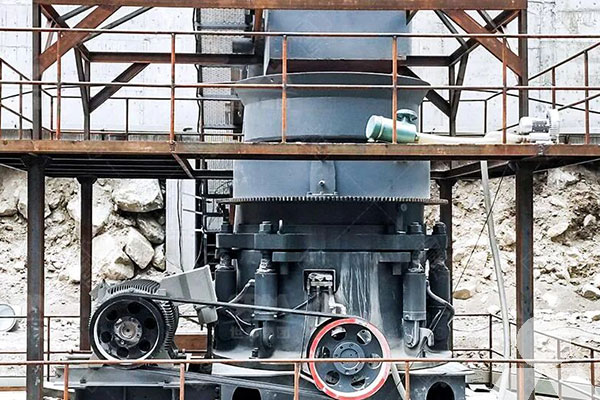
Handling large, high-hardness blocks demands immediate momentum transfer. The C6X125 jaw crusher utilizes a V-shaped crushing cavity designed to optimize the nip angle against irregular granite slabs. Maintaining the correct toggle plate alignment under a 500 tons per hour surge load prevents lateral material deflection, ensuring the raw feed enters the secondary stage without inducing catastrophic bridging. The distinct angularity of the crushed granite exiting the primary chamber requires a heavy eccentric shaft to absorb the extreme radial forces generated by 200MPa impact resistance.
Engineering Lamination Crushing for Strict Gradation Curves
System rebalancing hinges on precise CSS settings within a closed-circuit architecture to control aggregate flakiness.
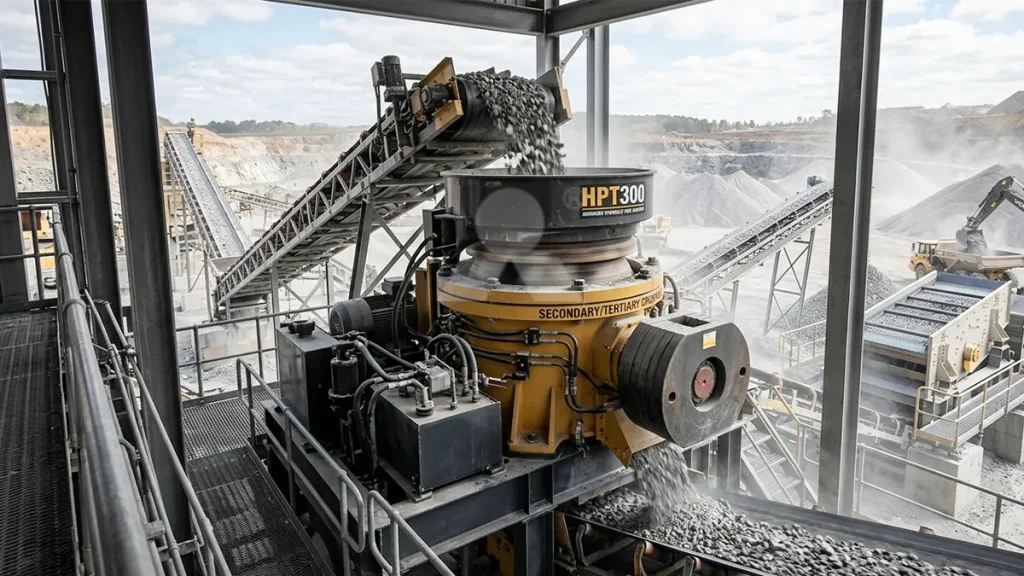
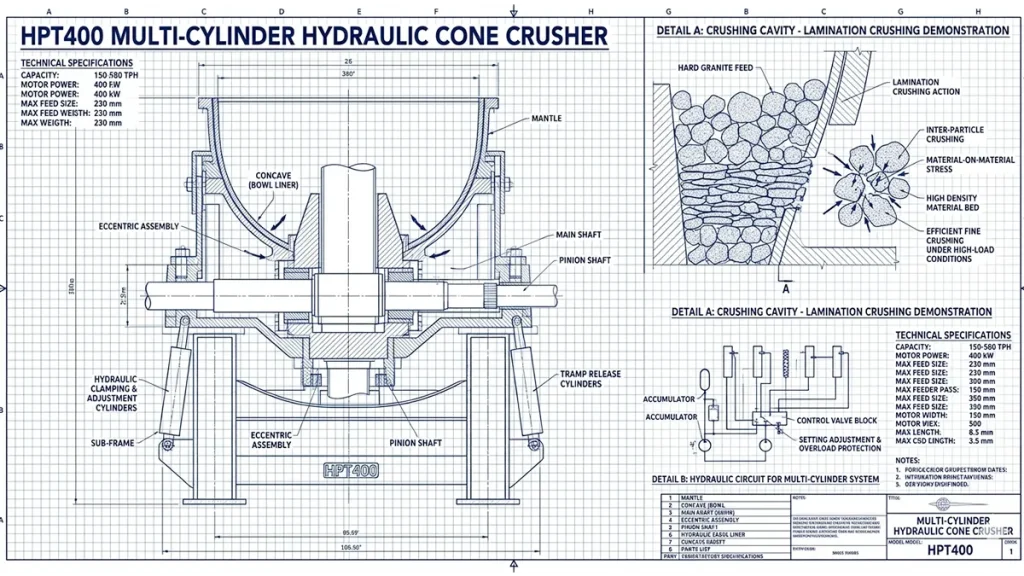
Generating premium 3/4" and 1/2" aggregate shapes strictly forbids standard impact reduction on high-silica rock. The HPT400 cone crusher executes lamination crushing physics, utilizing inter-particle friction rather than direct mantle-to-concave impact. Actively narrowing the CSS setting under a choked-feed condition forces the granite to fracture along natural fault lines. The synchronized hum of a balanced multi-stage circuit operating near 315 kilowatts confirms that the continuous gradation curve is being maintained, suppressing the elongation index of the final output. Replacing standard liners with reinforced manganese profiles extends the operational viability of the secondary and tertiary stages.
The Synchronized Equipment Matrix
To handle the abrasive silica of localized granite at high capacities, we have engineered the following multi-stage circuit focused on maximum system availability.
| Process Stage | Recommended Model | Capacity (tons per hour) | Max Feed (millimeters) | Power (kilowatts) |
|---|---|---|---|---|
| Primary Crushing | C6X125 | 230-760 | 800 | 160 |
| Secondary/Tertiary Crushing | HPT400 | 135-630 | 295 | 315 |
| Precision Grading | S5X2460-3 | 100-800 | 200 | 30 |
Synchronizing Amplitude and Frequency in Multi-Deck Architecture
High-capacity screening demands independent frequency control to prevent fine material bridging at 500 tons per hour.
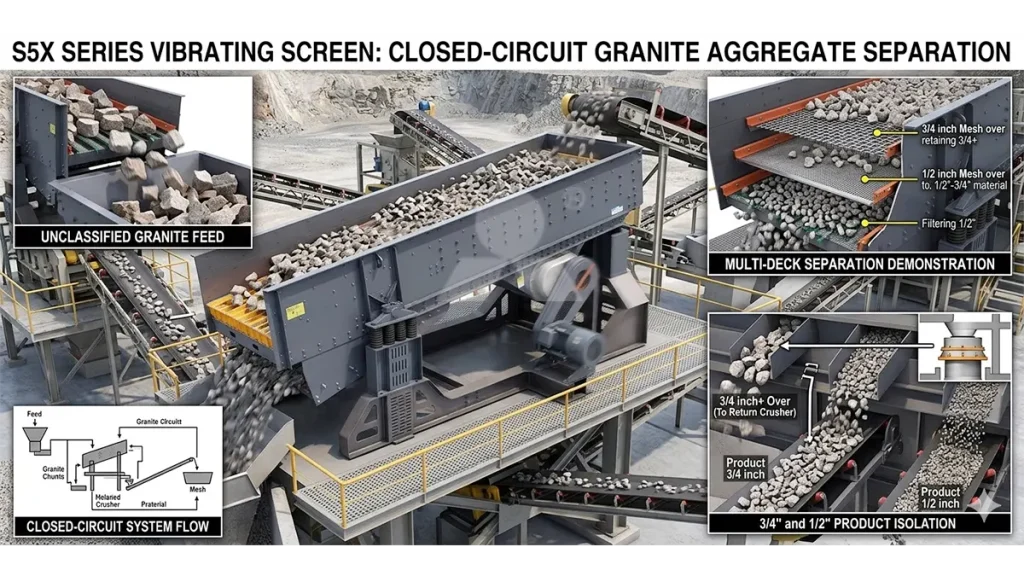
Sorting abrasive output into exact 3/4", 1/2", and 1/4" dimensions requires intense kinetic energy distribution. The S5X2460-3 vibrating screen separates high-density particles without allowing moisture-laden fines to form a sticky industrial paste across the lower mesh. Modulating the stroke amplitude ensures that the material bed remains highly fluidized, driving out undersized particles rapidly. Operating the entire system as a synchronized closed-circuit prevents oversized aggregates from escaping, routing them directly back to the tertiary HPT400 for structural refinement.
120tph Limestone Circuit: Motor Load & Vibration Thresholds
- Max Feed Specification: 800 millimeters (C6X125)
- System Availability Baseline: 500 tons per hour absolute throughput
- Primary Power Requirement: 160 kilowatts (C6X125)
- Secondary Power Requirement: 315 kilowatts (HPT400)
- Screening Architecture: 3-layer configuration (S5X2460-3)
Technical Index: LH-300-500TPH GRANITE CRUSHING PLANT IN ZIMBABWE-April/2026-Ref-#48192
Solution Architect's Log: Troubleshooting African Granite Circuits
- Why does the C6X125 frame vibrate excessively during peak throughput phases?
- Observing the anchor bolts usually reveals uneven concrete foundations, transferring the heavy rotor's kinetic energy into the base rather than concentrating the 160 kilowatts of crushing force onto the granite.
- How does lamination crushing eliminate the high flakiness index in 3/4" aggregate?
- Data proves that restricting the HPT400's discharge cavity forces rock-on-rock friction under 315 kilowatts of power, naturally fracturing the edges of elongated particles before they reach the 200 millimeter screening limit.
- What causes the S5X2460-3 to blind over when grading 1/4" fines?
- Ignoring the spring tension adjustments leads to insufficient deck amplitude; you must maintain rapid particle fluidization to overcome the surface moisture tension inherent in deep-pit granite.
- Why is continuous closed-circuit routing mandatory for the tertiary phase?
- Calculations show that allowing a wide CSS setting to increase sheer volume drops the structural integrity of the final gradation curve, severely elevating your single-ton wear part cost as oversized material attempts to bypass the system.
Defending System Availability in High-Volume Granite Circuits
Failing to lock the CSS settings on the HPT400 under the intense 315 kilowatts load will instantly degrade your gradation curve, flooding the tertiary screens with oversized slabs and causing a catastrophic downstream bottleneck by next month. Secure the closed-circuit loop.
Secure Your 500tph Infrastructure Viability
"Halt irregular grain shapes and eliminate blind screening bottlenecks." — From the Desk of your Solution Architect

Chief Technical Consultant
15+ Years in Mineral Processing & Mining Machinery
Senior mechanical specialist at Liming Heavy Industry. Leading expert in large-scale crushing circuits and global quarry optimization. His technical insights have helped over 500+ global projects achieve higher efficiency.