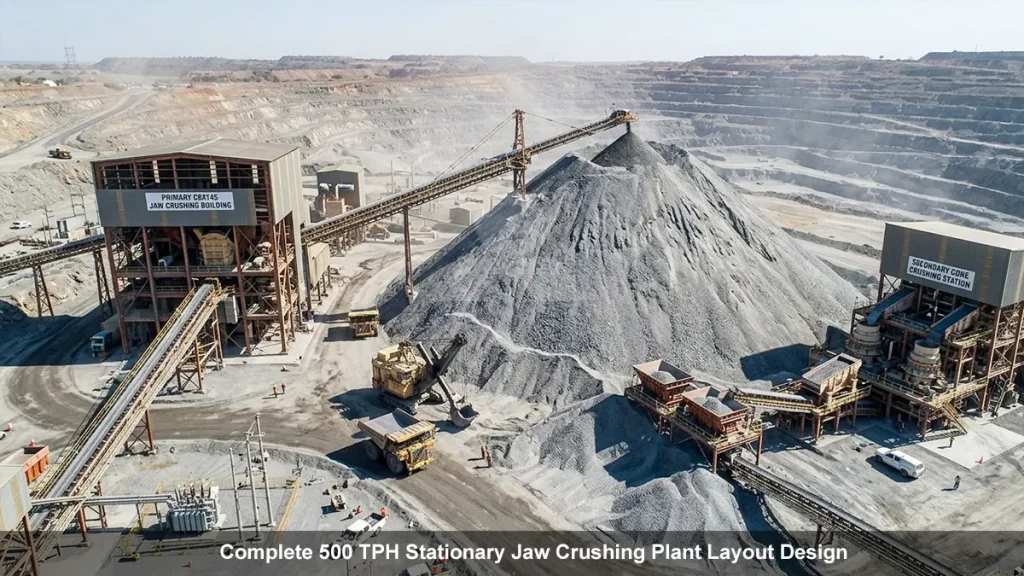
Complete 500TPH Stationary Jaw Crushing Plant Layout Design
A 500 tph primary circuit is not merely a collection of machines; it is a synchronized kinetic flow. Forcing 900mm granite through a C6X145 jaw without strict grizzly pre-screening stalls the 200kW motor. Failing to engineer a 2,000-ton intermediate surge pile guarantees that secondary bottlenecks will violently halt the primary jaw. Ignoring these spatial mass-balance realities destroys asset deployment velocity and multiplies daily expenditure per shift.
Grizzly Bypass and the 200kW Motor Stall
Failing to bypass -150mm fines packs the crushing cavity and instantly spikes the 200kW motor draw.
I constantly review flowcharts from amateur designers who treat the primary jaw as a universal funnel. It is not. Forcing 500 tph of 900mm granite through a C6X145 jaw crusher requires the F5X1860H feeder's grizzly bars to be precisely calibrated. If you feed dirt, clay, and undersized rock directly into the jaw's V-shaped cavity, the voids between the large boulders vanish. The material cannot compress.
The eccentric shaft attempts to force an uncrushable solid matrix.
This oversight creates immediate electrical violence. The 200kW motor spikes beyond its thermal limit, the breaker trips, and the entire primary circuit suffers a dead stall under full load. The architectural solution is non-negotiable: the -150mm fines must drop through the grizzly bars, bypass the jaw entirely, and land softly on the main discharge belt. This buffers the belt and preserves the crushing ratio.
Kinetic Bombardment and B6X Belt Laceration
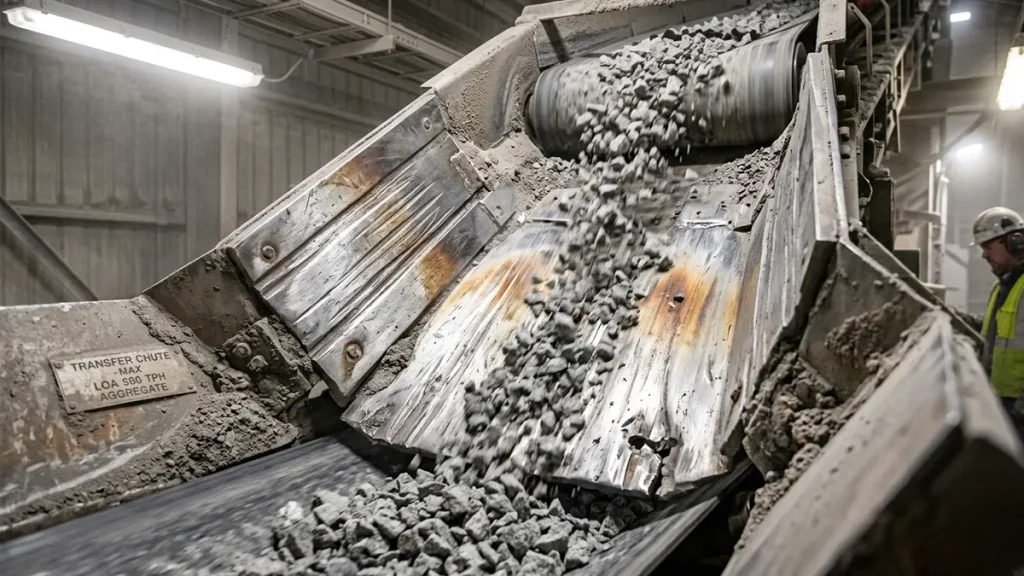
Discharging 500 tph of fractured 250mm basalt creates a massive kinetic bombardment. When rock exits the jaw, it accelerates via gravity. Omitting a dead-bed rock box and heavy-duty impact idlers beneath the jaw's discharge chute guarantees the B6X (1200mm width) rubber conveyor belt will be sliced open within 72 hours of operation.
The steel reinforcement inside the belt is no match for falling basalt.
In a professionally architected layout, we engineer a "rock-on-rock" transfer chute. We force the falling aggregate to land on a stationary bed of previously discharged rock, killing the kinetic energy before the material smoothly slides onto the moving rubber. You either engineer the dead-bed, or you accept the daily operational bleed of vulcanizing shredded belts.
To sustain a 500 tph mass balance, the primary extraction stage must be rigorously synced with the kinetic transfer layout.
| Process Stage | Recommended Model | Capacity (tons per hour) | Power (kilowatts) |
|---|---|---|---|
| Primary Feed Regulation | F5X1860H | 1200-1600 | 37 |
| Primary Crushing Engine | C6X145 | 320-950 | 200 |
| Main Kinetic Discharge | B6X-Width-1200 | 500 | 11 |
Notice the deliberate over-specification of the F5X1860H. While the C6X145 requires up to 950 tph peak intake, the feeder is rated for 1200-1600 tph. This massive reserve capacity ensures the vibrating pan never struggles under the weight of a full dump truck, allowing the variable frequency drive to perfectly meter the 500 tph baseline.
500tph Granite C6X145: Kinetic Integration Thresholds
- System Mass Flow: Sustained 495-512 tph under continuous excavator feed
- Primary Motor Draw: 200 kW (Monitored for overload protection)
- Grizzly Bar Spacing: 150 mm (Mandatory bypass for fines)
- Discharge Belt Width: 1200 mm (B6X specification)
- Transfer Chute Drop Height: Strictly limited to 2.5 meters
LH-COMPLETE_500TPH_STATIONARY_JAW_CRUSHING_PLANT_LAYOUT_DESIGN-April/2026-Ref-#82914
The Architectural Fatal Flaw: Missing Surge Piles
In a continuous 500 tph layout, omitting a minimum 2,000-ton intermediate surge pile between the primary jaw and secondary crushers is an architectural fatal flaw. Secondary cones are highly sensitive to moisture, tramp iron, and sensor trips. When the secondary circuit stops, the material flow must have somewhere to go.
Without a surge pile, the primary jaw is forced into a sudden emergency stop.
Stopping a fully loaded C6X145 jaw is dangerous; restarting it under load is destructive. The 200kW motor must overcome the static friction of 15 tons of wedged granite. The sheer stress transferred to the eccentric shaft and toggle plate during a cold, loaded restart severely degrades the structural lifespan of the machine. The surge pile acts as the vital mechanical lung of the operation.
Chute Abrasion and Drop Height Physics
Designing transfer chutes with a vertical drop height exceeding 2.5 meters without kinetic-breaking ledges accelerates abrasion exponentially. The friction from 500 tons of high-silica rock falling per hour acts like an industrial sandblaster. It will chew through 20mm Hardox steel wear plates in less than 30 days.
Field Note: In Western Australia, a poorly designed 4-meter freefall chute transferred 500 tph of quartzite. The impact friction melted the polyurethane liners and warped the structural steel frame before the first month of operation concluded.
A true Solution Architect dictates that the chute geometry must incorporate cascading rock-boxes. These stepped ledges force the material to collide with itself rather than the steel wall. If you fail to respect the kinetic trajectory of 500 tons of abrasive mass, your maintenance crew will spend every weekend cutting and welding new liners.
Enforcing Spatial Reality on 500 TPH Mass Flow
Paper designs do not survive kinetic reality. A 500 tph layout is a delicate balance of violent forces. If you fail to implement grizzly bypasses, dead-bed rock boxes, and 2,000-ton surge piles, the massive 200kW power of the C6X145 jaw will turn against the infrastructure itself. The continuous kinetic bombardment of fractured rock will lacerate your 1200mm belts and sheer your wear plates. Next month, ignoring these mass balance physics will result in a catastrophic motor stall and the total collapse of your capital payback velocity.
Redesign the transfer chutes and enforce the surge buffers immediately.
Eliminate kinetic bottlenecks and secure belt integrity.
"What is the exact vertical drop height from your primary jaw discharge to the B6X conveyor? Send me the dimensions, and let's calculate your impact abrasion rate." — From the Desk of your Solution Architect
STABILIZING PRODUCTION-TO-COST RATIO
Chief Technical Consultant
15+ Years in Mineral Processing & Mining Machinery
Senior mechanical specialist at Liming Heavy Industry. Leading expert in large-scale crushing circuits and global quarry optimization. His technical insights have helped over 500+ global projects achieve higher efficiency.