Essential Components of a Complete Crusher Production Line
This comprehensive guide breaks down every stage of a crushing plant (Feeding, Crushing, Screening, Conveying). It targets buyers needing a full system design and emphasizes Liming's ability to customize configurations for hard vs. soft rock.
For quarry owners and mining engineers, the difference between a profitable operation and a costly money pit often lies in the plant configuration. Are you struggling with frequent downtime, uneven particle shapes, or high energy costs? These issues usually stem from a mismatch in the system's design. Understanding the components of a complete crusher production line is the first step toward building a facility that guarantees high output and low operational costs.
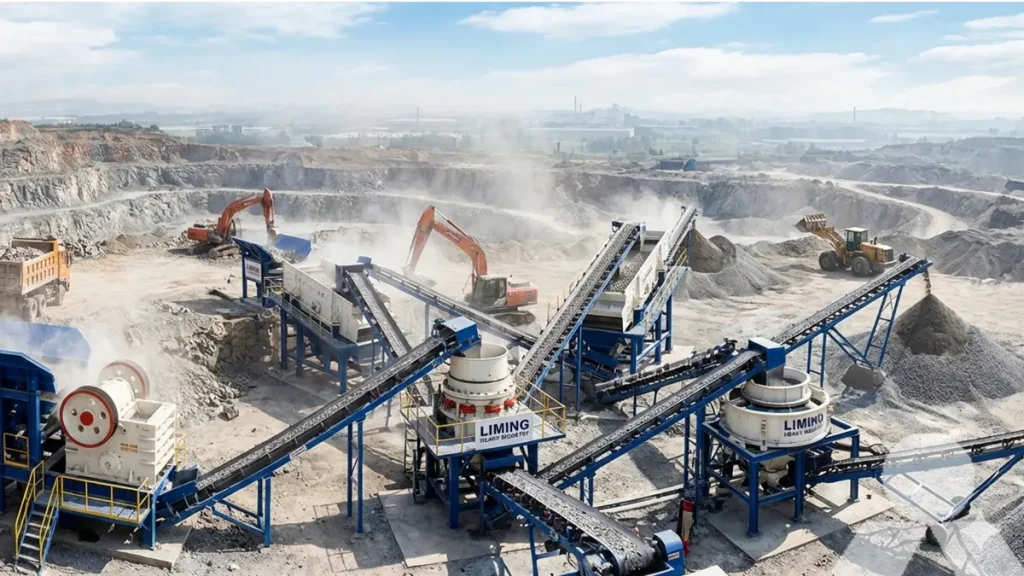
A crushing plant is not just a collection of machines; it is a synchronized system where every piece of equipment plays a vital role. At Liming Heavy Industry, we don't just sell machinery; we engineer complete solutions tailored to your raw material and capacity needs. In this guide, we will dissect the anatomy of a high-performance crushing line and explain how each component contributes to your bottom line.
The Anatomy of a Crushing Plant: Core Components Breakdown
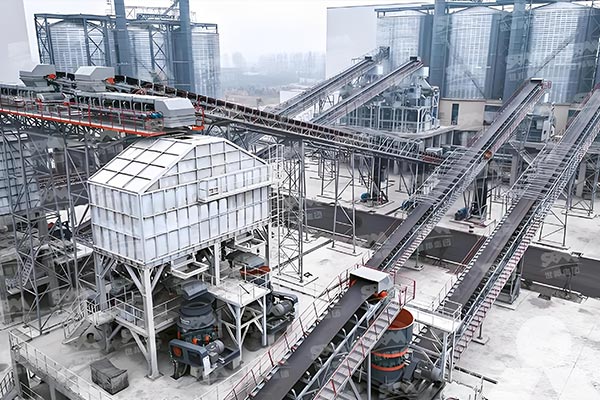
A standard stone crushing production line consists of four main systems: Feeding, Crushing, Screening, and Conveying. Below is a detailed analysis of the specific equipment involved in each stage.
1. Feeding System: The Vibrating Feeder
The process begins here. The Vibrating Feeder is responsible for feeding raw materials into the primary crusher evenly and continuously. Without a stable feeder, the crusher would either run empty or become choked, leading to wear and inefficiency.
- Key Equipment: GZD Series or ZSW Series Vibrating Feeder.
- Function: Pre-screening fines (to reduce crusher load) and uniform feeding.
- Why Liming: Our feeders feature a double eccentric shaft vibration exciter, ensuring strong excitation force and stable amplitude.
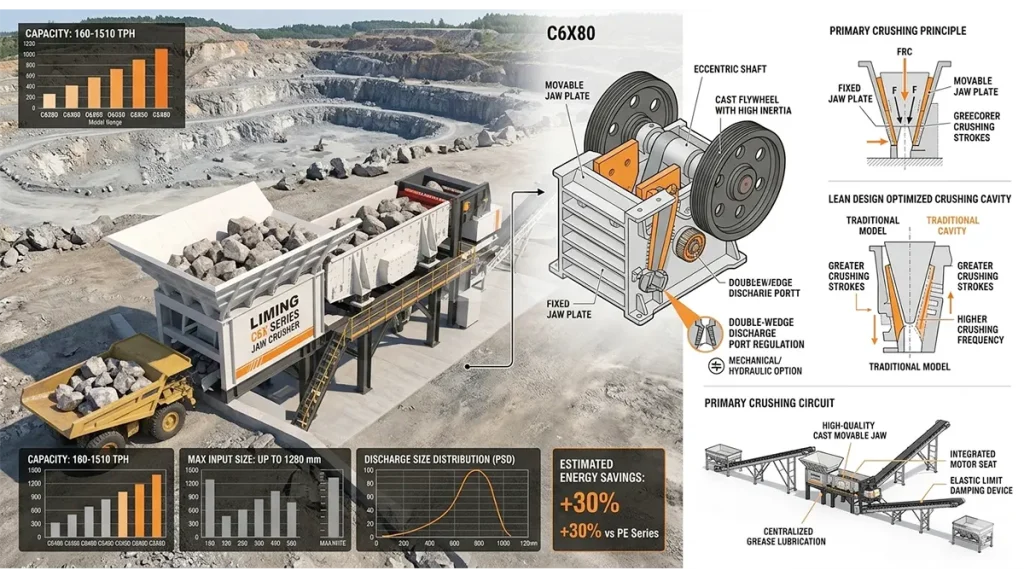
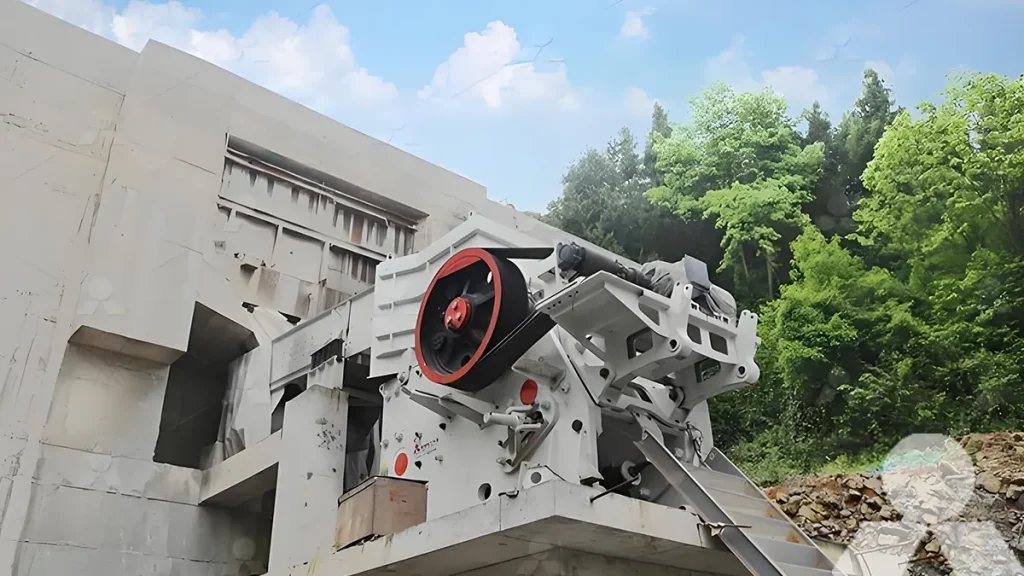
2. Primary Crushing: The Jaw Crusher
The "Head Crusher." The Jaw Crusher is the heavy lifter designed to handle large boulders and reduce them to a manageable size for secondary crushing.
- Key Equipment: PE, PEW, or C6X Series Jaw Crusher.
- Role: Coarse crushing. Handles high compression strength materials like basalt and granite.
- Highlight: Liming’s C6X series adopts a bolting-connection structure without welding, ensuring higher durability and easier maintenance.
3. Secondary and Tertiary Crushing
Once the material is reduced by the Jaw Crusher, it moves to the secondary stage for fine shaping and further size reduction. The choice of equipment here depends entirely on the hardness of your stone.
Option A: For Hard Rock (Granite, Basalt, River Pebble)
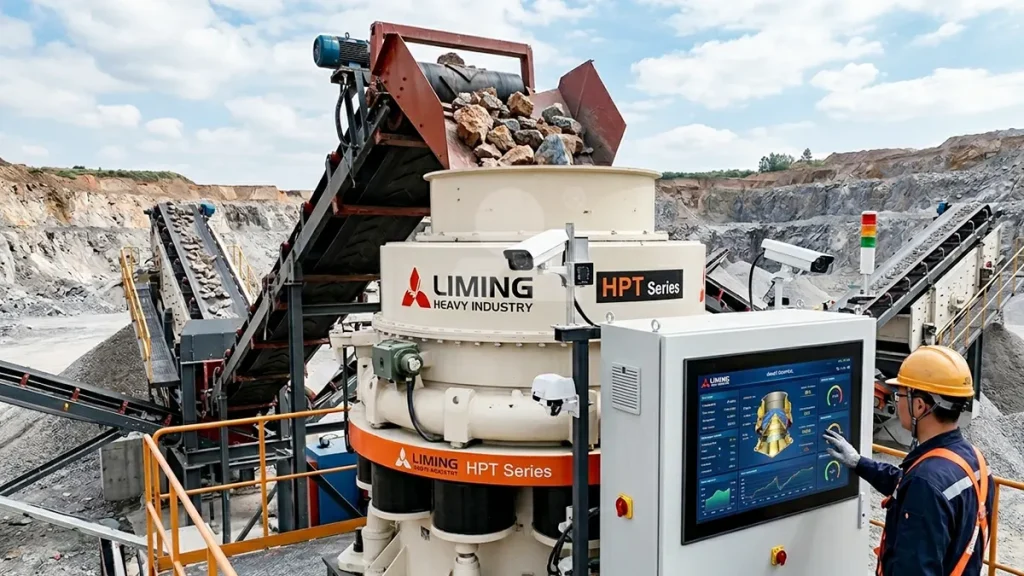
Equipment: Cone Crusher (HST or HPT Series).
Why: Cone crushers use a lamination crushing principle that is ideal for hard, abrasive materials. They offer low wear costs and high output.
Option B: For Soft/Medium Rock (Limestone, Gypsum, Coal)
Equipment: Impact Crusher (PF or PFW Series).
Why: Impact crushers produce excellent cubic particle shapes and are less expensive to buy, though they are not suitable for highly abrasive rock.
4. Screening System: The Vibrating Screen
The Vibrating Screen acts as the quality control checkpoint. It separates the crushed stone into different specifications (e.g., 0-5mm, 5-10mm, 10-20mm).
- Key Equipment: YZS Series Vibrating Screen.
- Function: Circular trajectory vibration allows for high screening efficiency. Oversized materials are sent back to the secondary crusher for re-crushing (Closed Circuit).
5. Conveying System: Belt Conveyors
The arteries of the plant. Belt Conveyors connect all the equipment, transporting material from one stage to the next and finally to the stockpiles.
- Requirement: Must be durable, weather-resistant, and correctly angled to prevent material rollback.
6. Electric Control System
Often overlooked, the Electronic Control Panel is the brain of the operation. Modern Liming plants come with integrated control systems that allow operators to monitor current, oil temperature, and pressure, ensuring safe operation.
Configuration Principles: Selecting the Right Components
Not all production lines are created equal. Choosing the right components of a complete crusher production line depends on specific project parameters. Refer to the comparison below to guide your decision:
| Project Parameter | Recommended Configuration | Liming Solution Advantage |
|---|---|---|
| High Hardness (Granite/Basalt) | Jaw Crusher + Cone Crusher | Lower wear part consumption; Hydraulic protection. |
| Soft Material (Limestone) | Jaw Crusher + Impact Crusher | Superior particle shape (Cubic); Lower initial investment. |
| Sand Making (Artificial Sand) | Add VSI Sand Maker (VSI6X) | Produces high-quality sand comparable to natural river sand. |
| Mobile Projects | Mobile Crushing Station (K Series) | Eliminates piling work; Move freely between sites. |
Frequently Asked Questions (FAQ)
1. What is the estimated cost of a complete crusher production line?
The cost varies significantly based on capacity (TPH) and configuration. A small 50 TPH limestone line will be much cheaper than a 500 TPH granite line. Contact Liming Heavy Industry for a detailed quote based on your specific requirements.
2. How do I maintain the components of the production line?
Regular maintenance includes checking the lubrication of bearings, inspecting wear parts (jaw plates, blow bars, mantles) for replacement, and ensuring belt conveyors are aligned. Liming provides detailed manuals and on-site training for your team.
3. Can one production line handle different types of rocks?
Yes, but efficiency may vary. For example, a line designed for limestone (Impact Crusher) should not process granite long-term due to high wear costs. A line designed for granite (Cone Crusher) can process limestone but may produce more flaky particles. We recommend configuring the line based on your primary material.
Build Your Success with Liming Heavy Industry
Investing in the right components of a complete crusher production line is crucial for ensuring the longevity and profitability of your mining or quarrying project. From the rugged Jaw Crusher to the precision of the Vibrating Screen, every machine must work in harmony.
Liming Heavy Industry brings decades of experience in designing plants that withstand the toughest environments in Africa, Southeast Asia, and South America. Don't settle for generic solutions.

Chief Technical Consultant
15+ Years in Mineral Processing & Mining Machinery
Senior mechanical specialist at Liming Heavy Industry. Leading expert in large-scale crushing circuits and global quarry optimization. His technical insights have helped over 500+ global projects achieve higher efficiency.