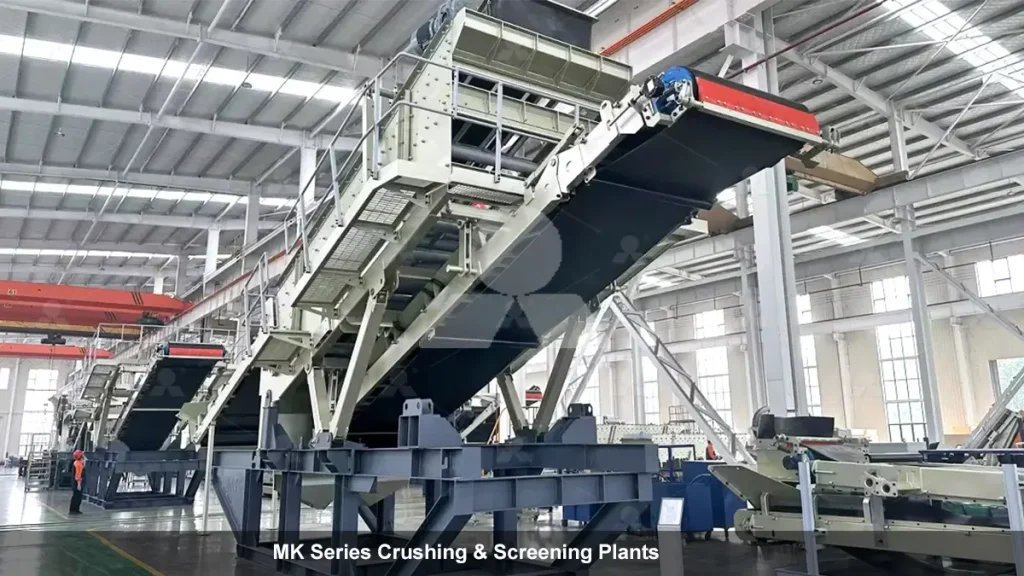
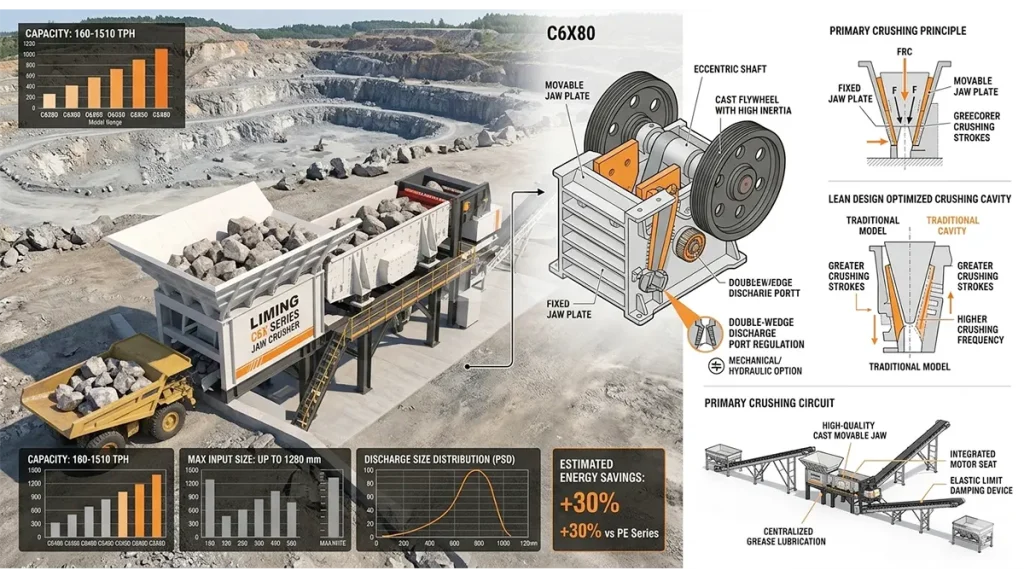
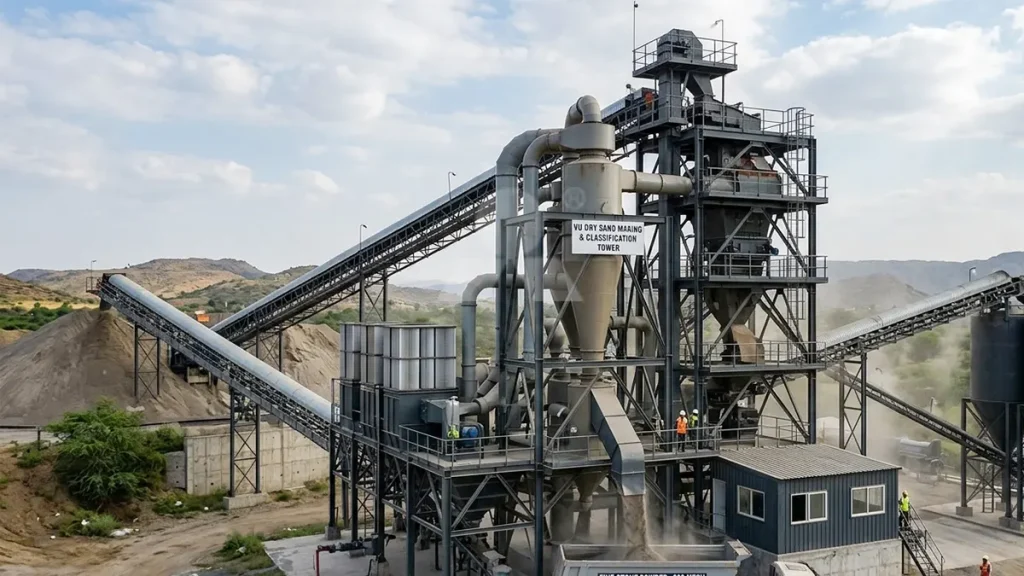
Dry Type Artificial Sand Manufacturing Process Flowsheet
Industrial water dependencies cripple aggregate profitability in arid environments. By engineering a strictly dry aerodynamic classification loop, operators eliminate settling ponds and lock stone powder content at 7%. This audit deconstructs the mechanical synchronization between VSI rock-on-rock kinematics and closed-circuit air separation.
- Zero Water Dependency: Aerodynamic classification entirely replaces XSD wheel washers, neutralizing the 1.5-ton water requirement per ton of processed aggregate.
- Fineness Modulus Calibration: Rock-on-rock kinematics stabilize the FM at exactly 2.8, stripping micro-fractures from the 0-5mm output.
- Powder Content Lock: Dynamic air classifiers isolate and extract 0.075mm (200 mesh) micro-fines, capping final stone powder retention at a strict 7%.
During a March 2025 flowsheet audit for a 200 TPH limestone circuit in Riyadh, Saudi Arabia, environmental realities dictated a strictly dry process. Traditional wet sand washing consumes up to 1.5 tons of water per ton of aggregate and requires massive settling ponds. The capital outlay for sludge treatment alone destroys the production-to-cost ratio in arid zones. By engineering a dry aerodynamic classification flowsheet, we entirely bypassed industrial water dependencies. The physical layout shifted from sprawling wet plant logistics to a vertically integrated closed-circuit loop, ensuring every kilowatt of energy was spent on material shaping rather than fluid management.
VSI Kinematics and Grain Shape Mass Balance
Forcing oversized material through a weak rotor destroys your fineness modulus and spikes your expenditure per shift.
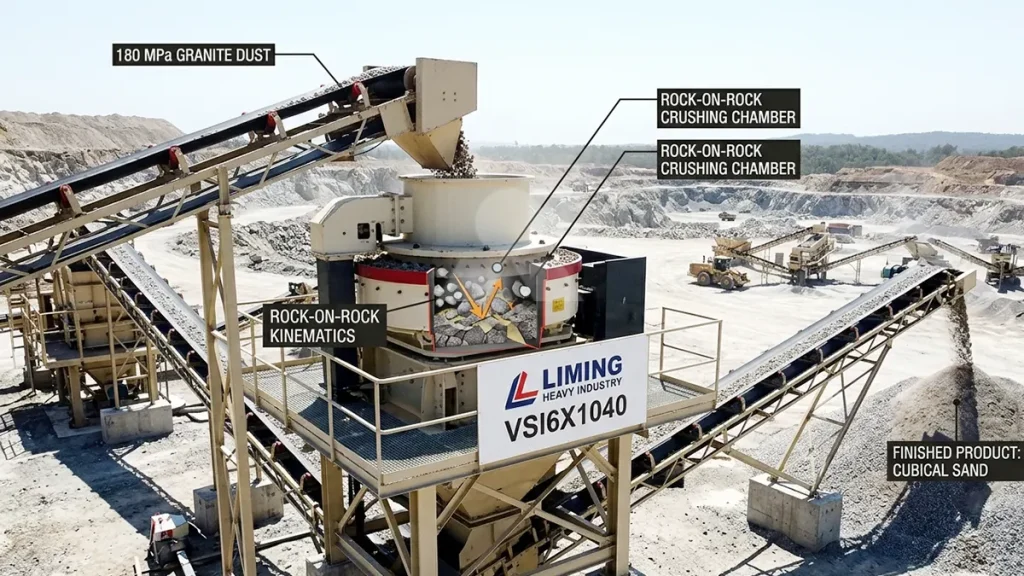
At the core of the flowsheet, we deployed the VSI6X1150 Sand Maker operating at 250 kW. You cannot achieve premium concrete-grade sand using standard compression crushers. Instead of metallic impact, we utilized 'rock-on-rock' (stone-strike-stone) crushing kinematics within the deep-cavity rotor. The raw limestone is accelerated to extreme velocities, creating a dense particulate cloud where material collides against its own mass.
This high-velocity particle collision stripped away internal micro-fractures inherently caused by primary jaw extraction. The kinetic energy specifically targets the weakest structural planes of the rock. The result is a continuous output of 0-5mm artificial sand with a perfectly spherical grain shape. We stabilized the Fineness Modulus (FM) at exactly 2.8. If you rely on metallic anvil impacts (stone-on-iron), the high-silica friction will melt your wear parts and contaminate the grain profile with elongated splinters.
Aerodynamic Powder Separation vs. Wet Washing Expenditure
To replace the traditional XSD wheel washer, the undersized material from the S5X vibrating screen was fed directly into a dynamic air classifier. Dumping water on crushed rock is an outdated, brute-force method that washes away profitable fine aggregates along with the mud. In a dry flowsheet, gravity and controlled wind velocity handle the separation.
By calibrating the internal wind velocity of the classifier, we selectively extracted the extreme 0.075mm (200 mesh) micro-fines. The bone-dry limestone dust is suspended in the aerodynamic chamber, where heavy usable sand drops out and the microscopic powder is pulled into a pulse-jet baghouse dust collector. This aerodynamic adjustment locked the final stone powder content at precisely 7%. You meet premium concrete batching standards without spilling a single drop of water, instantly converting what used to be toxic sludge into a sellable dry filler byproduct.
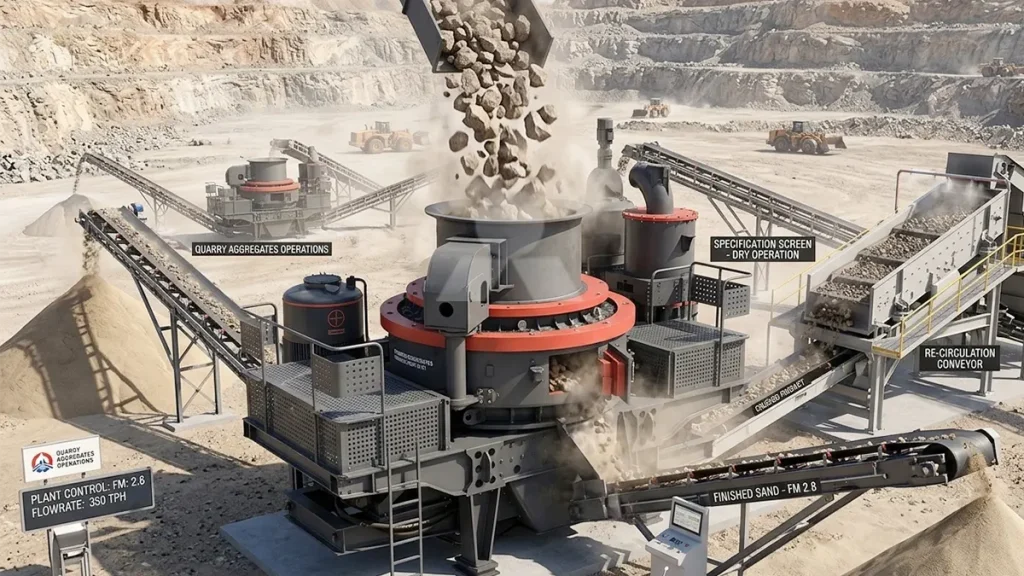
To execute a flawless dry sand manufacturing process, we strictly synchronized the following mechanical matrix to ensure zero bottlenecking between the shaping and classification stages.
Mismatching your screening capacity with your air classifier volume guarantees a catastrophic backflow of 200-mesh powder.
| Process Stage | Recommended Model | Capacity (tons per hour) | Power (kilowatts) | Output Size (millimeters) |
|---|---|---|---|---|
| Kinematic Shaping | VSI6X1150 | 344-663 | 250 | 0-5 |
| High-Frequency Grading | S5X2160-3 | 85-700 | 30 | Multiple Fractions |
| Aerodynamic Classification | VU Tower System | 60-300 | System Dependent | 0.075 Extraction |
By integrating the VU dry sand making tower layout, we configured a strict closed-circuit loop where oversized material (>5mm) is continuously returned to the VSI6X. This vertical integration reduced the total site footprint by 60% compared to a sprawling wet plant. You drastically lower the initial land acquisition expenditure while ensuring a 100% mechanical utilization rate of the raw limestone.
Arresting Mass Balance Failures at the 0.075mm Threshold
The mechanical reality of artificial sand production relies entirely on strict powder control. If you ignore the 0.075mm micro-fines ratio and attempt to run a dry circuit without precise aerodynamic classification, you are not producing aggregate; you are producing contaminated dust. Forcing a VSI6X to run without a properly calibrated closed-circuit feedback loop will instantly destroy your grain shape and spike your daily running costs. Managing the exact wind velocity inside your classifier is the non-negotiable operational boundary that separates premium concrete sand from rejected waste. If you do not lock your stone powder content at 7% via aerodynamic extraction, your entire downstream supply chain will experience a catastrophic mass balance failure before the end of the shift.
Stop Guessing on Micro-Fines Extraction Ratios
"Aerodynamic separation is not an accessory; it is the physical baseline for dry circuit survival." — From the Desk of your Solution Architect
Audit Aerodynamic Production-to-Cost Ratio
Chief Technical Consultant
15+ Years in Mineral Processing & Mining Machinery
Senior mechanical specialist at Liming Heavy Industry. Leading expert in large-scale crushing circuits and global quarry optimization. His technical insights have helped over 500+ global projects achieve higher efficiency.