How to Set Up a Profitable Concrete Recycling Plant?
Moisture and rebar entanglement destroy baseline profitability in concrete recycling. Stripping rate and slag removal efficiency dictate the capital payback velocity. By configuring C6X jaw crushers and CI5X impactors with magnetic separation, operations secure ESG subsidies and bridge the Recycled Concrete Aggregates (RCA) deficit in the precast market.
Tracking capital flow across 50 urban demolition sites in early 2026 exposes a critical financial failure: most operators bleed their potential margins on excessive wear-part consumption and poor slag removal efficiency. The primary driver of profitability is no longer sheer crushing tonnage. Securing a rapid profitability timeline requires engineering an asset configuration that produces high-grade Recycled Concrete Aggregates (RCA) while maximizing the secondary revenue stream from scrap steel recovery.
2026 Capital Window: ESG Subsidies and RCA Deficits
Global carbon reduction mandates have irreversibly shifted the economics of demolition waste.
Municipalities are aggressively penalizing landfill disposal while introducing green subsidies for localized waste-to-resource operations. The market analysis reveals a massive supply-and-demand gap for RCA in road base construction and non-load-bearing precast markets. Traditional virgin aggregates face strict mining quotas and volatile transport logistics. Operators who can deliver certified RCA with a consistent grain shape instantly capture local market dominance and qualify for substantial ESG-linked capital injections.
Focusing purely on crushing concrete ignores the secondary revenue matrix. The fiscal reality of a 2026 plant hinges on the ability to isolate and monetize steel rebar without destroying the crushing chamber mechanics. Ignoring this dual-yield approach extends the asset amortization cycle by months.
Asset Configuration: Maximizing Stripping Rate and Fiscal Efficiency
Financial viability relies on a logical flowsheet: pre-treatment, primary crushing, magnetic iron removal, secondary crushing, and final screening.
Dumping raw demolition debris into a generic crusher guarantees immediate catastrophic wear. The C6X110 Jaw Crusher serves as the primary defense line, accepting feeds up to 720mm. Its bolted, non-welded frame prevents structural fatigue under the violent, unpredictable stress of mixed concrete and embedded steel. This primary stage fractures the concrete envelope, initiating the critical stripping rate required to expose the rebar.
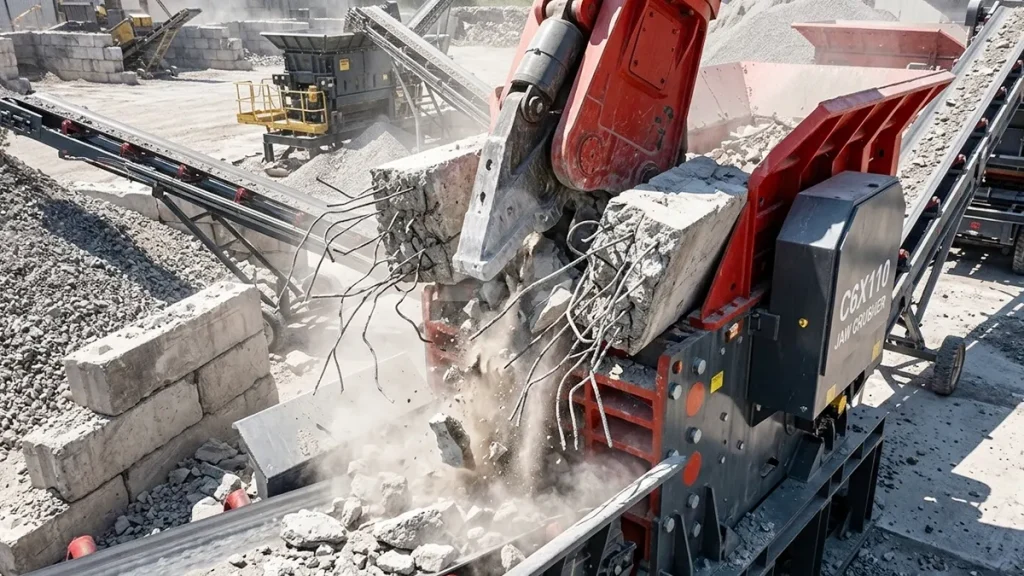
Following the primary stage, a high-intensity magnetic separator intercepts the material flow. An optimized rebar separation rate prevents unyielding steel from entering the secondary circuit. For shaping the RCA to precast standards, the CI5X1315 Impact Crusher dominates the secondary stage. Generating 250-350 tons per hour, it utilizes high-chrome blow bars to deliver the precise cubical grain shape demanded by commercial asphalt and road base contractors. The integration of a frequency conversion control system allows operators to adjust rotor speeds dynamically, matching expenditure per shift directly to the hardness of the incoming feed.
Equipment Architecture: Tracked Assets vs. Stationary Capital
The upfront equipment price must align with the duration and geographic spread of the demolition contracts.
Stationary plants offer lower operating costs over a 10-year horizon, but mobile units dominate rapid-deployment urban scenarios. Selecting the wrong asset class traps capital in concrete foundations or incurs unnecessary diesel premiums.
| Deployment Strategy | Recommended Primary Asset | Capacity (tons per hour) | Power (kilowatts) | Capital Risk Profile |
|---|---|---|---|---|
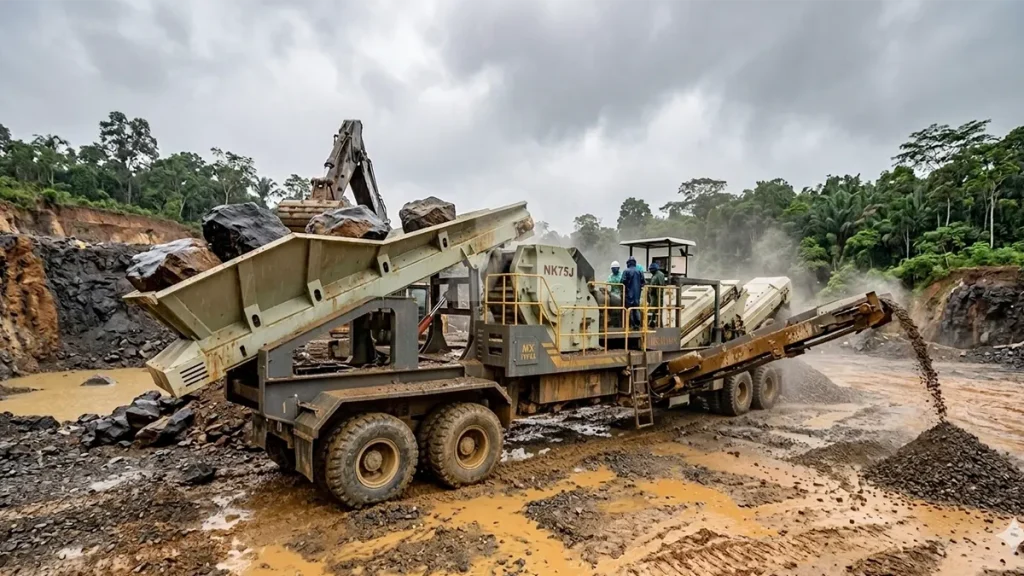
| Mobile Rapid-Response | MK110J Jaw | 160-420 | 160 | High asset mobility, zero foundation costs, elevated daily running costs. |
| Stationary Central Hub | C6X110 Jaw Crusher | 160-550 | 160 | Lower power expenditure per shift, full environmental enclosure, requires long-term land lease. |
Financial Dynamics: Expenditure Per Shift vs. Yield
Single-ton disposal costs dictate the viability of the entire operation.
To accurately project the capital payback velocity, investors must audit the micro-economics of the plant. The cost per ton of aggregate encompasses grid power consumption (or diesel fuel), operator labor, and the rapid depreciation of impactor blow bars when processing highly abrasive concrete. If the rebar separation rate drops below 95%, tramp metal will destroy the CI5X blow bars, instantly inflating the daily running costs.
Revenue mapping involves two distinct streams. The primary yield is the sale of certified RCA to municipal projects. The secondary, often more lucrative yield per ton, is the extracted scrap steel. A properly synchronized plant running a C6X and CI5X circuit limits manual intervention, stabilizes the production-to-cost ratio, and significantly accelerates the capitalization yield.
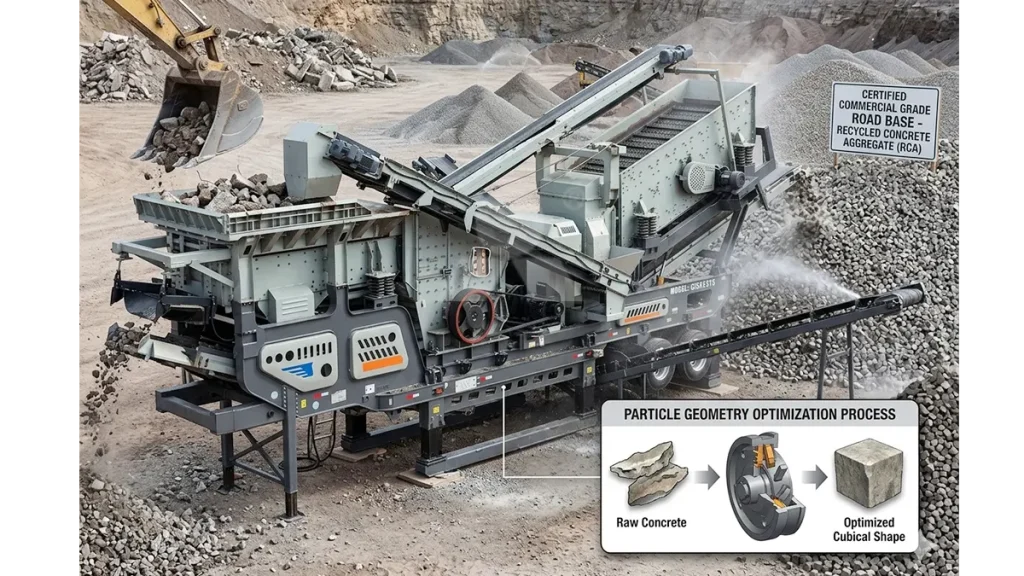
Fiscal Wear Benchmarks: C6X110 & CI5X1315 Asset Metrics
- Secondary Power Expenditure: 250-315 kilowatts (CI5X1315)
- Primary Input Ceiling: 720 millimeters Max Feed (C6X110)
- Secondary Volume Output: 250-350 tons per hour (CI5X1315)
- Primary Volume Output: 160-550 tons per hour (C6X110)
- Primary Power Expenditure: 160 kilowatts (C6X110)
Technical Index: LH-HOW TO SET UP A PROFITABLE CONCRETE RECYCLING PLANT?-April/2026-Ref-#48291
Investor Audit: Identifying Revenue Leaks in RCA Processing
- Why does the CI5X1315 register severe energy spikes during continuous concrete processing?
- Analyzing the power draw data reveals that inadequate primary stripping rate forces the impactor to process large, unbroken steel fragments. This mechanical resistance demands excess amperage from the 250-315 kW motor, degrading fiscal efficiency.
- How does moisture content in demolition waste impact the capital payback velocity?
- Regional precipitation turns fine concrete dust into a dense industrial cement. This material blinds the pre-screening mesh, forcing undersized dirt through the C6X110 jaw, drastically accelerating wear part degradation and bloating expenditure per shift.
- What financial risk exists if the magnetic separator is bypassed to increase throughput?
- Sacrificing the rebar separation rate immediately exposes the high-chrome blow bars to unyielding steel impacts. The cost of replacing a shattered CI5X rotor assembly obliterates any short-term production gains and halts the profitability timeline.
- Why is a tracked mobile solution often preferred despite higher initial investment pricing?
- Fiscal volatility models demonstrate that eliminating haulage costs by processing waste directly on the demolition site frequently offsets the diesel premium. The MK110J eliminates the need for expensive poured foundations, allowing capital to remain liquid and adaptable.
Securing Asset Amortization in High-Volume Demolition Circuits
Failing to establish a rigorous pre-treatment protocol ensures that the aggressive abrasiveness of mixed concrete will shred the financial viability of the crushing circuit within a single financial quarter, rendering the 160 kW motor of the primary jaw an active liability rather than an asset. Synchronize your magnetic separation with the C6X output immediately, or watch structural fatigue permanently halt your capital payback velocity next month.
Stop Guessing on Rebar Wear Cycles
"Evaluate your site's true stripping rate and protect your capital flow." — From the Desk of your Investment Strategist

Chief Technical Consultant
15+ Years in Mineral Processing & Mining Machinery
Senior mechanical specialist at Liming Heavy Industry. Leading expert in large-scale crushing circuits and global quarry optimization. His technical insights have helped over 500+ global projects achieve higher efficiency.