Impact Crusher vs. Jaw Crusher: Which is Better for Concrete Waste?
Choosing the right primary unit for concrete demolition hinges on raw material steel content and final aggregate destination. Compressive jaw physics easily handle massive reinforced slabs, while high-velocity impactors provide the aggressive stripping rate required for high-margin, perfectly cubic recycled aggregate.
Based on my field audits across urban demolition zones in early 2026, the most devastating mistake contractors make isn't buying an underpowered machine—it is fundamentally mismatching crushing physics to the actual waste stream. When you are standing ankle-deep in dust, staring at a pile of demolished bridge pillars, looking at a glossy catalog will not save you. You must evaluate the raw material's internal steel content and the final aggregate's required commercial destination. Selecting the right primary unit is not a debate over initial investment; it is strictly about managing brutal physical realities like heavy rebar and securing a profitable outlet for the crushed product.
First-Line Defenses: The C6X Jaw on 500mm+ Reinforced Slabs
To survive monolithic 500mm concrete blocks embedded with thick steel, you need brute compressive force and massive material flow capacity.
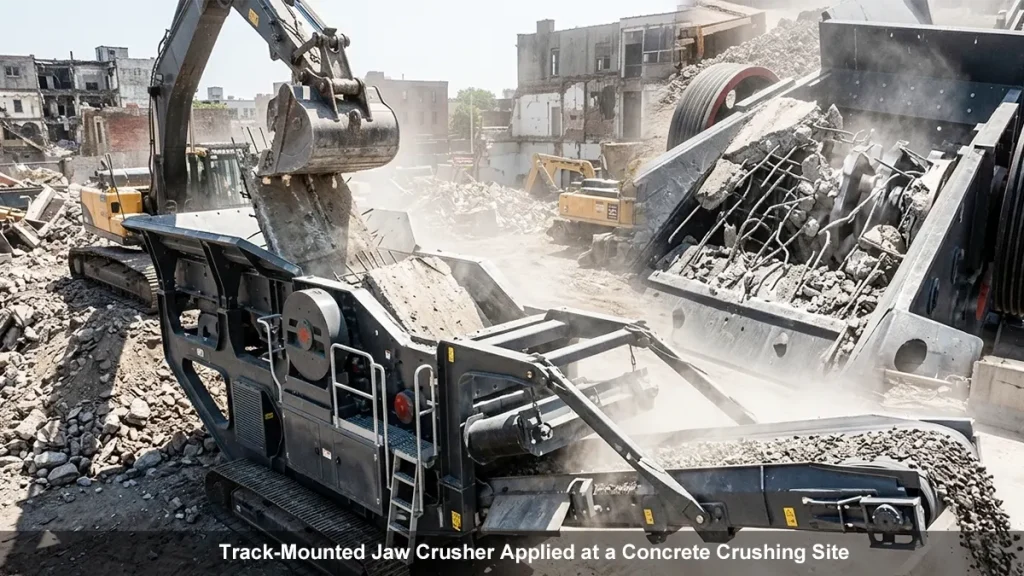
The jaw crusher acts as the undisputed gatekeeper on a demolition site. In my experience, when an excavator drops a half-ton piece of a structural column into the hopper, finesse is useless. You need the deep cavity and large eccentric shaft stroke of a unit like the C6X100. This geometry allows the machine to physically grip and fracture 630mm chunks of cured concrete without stalling the 110 kW motor. The raw compressive force breaks the concrete bond just enough to let the underlying steel breathe.
Rebar entanglement is the primary killer of urban recycling operations. The simple, heavy-duty toggle plate and swing jaw action of the C6X naturally pinch and snap the concrete, allowing long, twisted strands of rebar to pass through the discharge opening relatively undisturbed. You will feel the heavy, rhythmic vibration through your steel-toed boots, and you will hear the sharp, metallic screech of exposed steel scraping against the manganese jaw plates. That horrific sound means the machine is surviving. Dropping a heavily reinforced 500mm slab directly into an impact chamber is a guaranteed recipe for a catastrophic rotor jam.
High-Velocity Stripping: The CI5X Impactor's Output Advantage
Generating premium recycled aggregate requires shattering the cement paste bond, a task where high-speed impact physics completely outperforms slow compression.
While the jaw survives the massive slabs, its compressive action produces a high flakiness/elongation index. Nobody at a commercial batching plant wants needle-shaped rocks—they ruin the structural integrity and workability of new concrete. This is where the CI5X1213 impact crusher alters your operational profitability. By utilizing a massive rotor and heavy-duty blow bars spinning at extreme velocity, the impactor delivers a violent, kinetic shockwave directly to the incoming material.
This aggressive energy forces the concrete to fracture along its natural fault lines—specifically at the boundary between the original aggregate and the old cement paste. The resulting stripping rate is phenomenal. The cement crust shatters off completely, leaving behind clean, high-quality particles characterized by excellent product shape and pure cubicity. The unavoidable physical trade-off is accelerated blow bar wear. Managing the feed size to strictly under 550mm and ensuring primary magnetic separation has removed the heavy steel is critical to keeping the impactor's expenditure per shift under control.
The Field Diagnostic Decision Model for Urban Demolition
There is no universal superior machine; fiscal efficiency per unit dictates that you align the crushing chamber with your specific contract requirements.
Under specific site conditions, each machine establishes absolute operational dominance. If your contract only requires producing rough road subbase fill, and you need to keep daily running costs as low as possible, the jaw crusher holds the advantage. It ignores the structural steel, maximizes material flow capacity, and gets the tonnage out the gate.
If your ultimate target is selling recycled aggregate back into the high-margin commercial concrete market, the impactor is mandatory. The premium paid for perfect cubicity easily offsets the increased wear parts budget.
For serious, long-term operations targeting over 300 tons per hour, the undisputed engineering strategy is the two-stage circuit. You deploy a C6X jaw pulling primary duty to snap the slabs and extract the heavy steel, feeding a CI5X impactor to shape the final product. In tight urban demolition zones where footprint is limited, mounting these distinct crushing modules on a tracked mobile station provides the ultimate flexibility, allowing you to drive the exact physics you need directly to the rubble pile.
Field Wear Benchmarks: Synchronizing CI5X1213 with High-Yield Concrete Recovery
- Motor Rating: 200-250 kW
- Max Feed: 550 mm
- Primary Limitation: Un-cut structural rebar
- Target Metric: 100% Cubicity for Batching Plants
- Production Band: 200-300 tph
Technical Index: LH-IMPACT-CRUSHER-VS.-JAW-CRUSHER:-WHICH-IS-BETTER-FOR-CONCRETE-WASTE?-April/2026-Ref-#48291
Shift Lead's Log: Rebar Defenses and Blow Bar Wear Dynamics
- Why does the CI5X1213 rotor stall immediately when fed 600mm structural columns?
- Standing on the catwalk, you can see exactly why: the CI5X1213 has a strict 550mm max feed limit. Pushing a 600mm slab into the chamber wedges the material between the blow bar and the impact rack, overloading the 250 kW motor instantly and causing severe mechanical seizure.
- How does the C6X jaw manage steel without severing the conveyor belt?
- Compared to older compression setups, the large eccentric throw of the C6X series folds the rebar rather than shearing it into razor-sharp fragments. The long steel strands exit the 630mm chamber relatively intact, making it incredibly easy for the downstream cross-belt magnet to pull them off before they puncture the rubber.
- Stop ignoring the stripping rate if you want to sell to commercial mixers.
- If you rely solely on a jaw crusher, the cement paste remains glued to the original stone. When mixed into new concrete, this old paste absorbs excess water, destroying the batch's compressive strength. High-speed impact is the only way to physically shear that paste off.
- At what point does blow bar wear make the impactor financially unviable?
- When the feed material is not pre-screened and dirt or highly abrasive silica sand bypasses the primary stage, you will see your manganese blow bars degrade by 15% in a single 12-hour shift. Pre-screening the fines is non-negotiable for preserving your expenditure per shift.
Enforcing Asset Viability in Urban Concrete Demolition Circuits
Feeding monolithic concrete blocks laden with heavy steel directly into a high-speed rotor without a primary compressive defense will destroy your 250 kW motor and shatter your blow bars before the shift ends, proving that you must respect the 550mm max feed limit of the CI5X. Secure your site's profitability by forcing a strict two-stage process where the jaw handles the brutal extraction and the impactor handles the high-margin shaping.
Stop Guessing on Rebar Extraction Cycles
"Evaluate your exact steel-to-concrete ratio before committing your capital." — From the Desk of your Site Lead
Calculate Construction Waste Specific Crusher Fiscal Efficiency

Chief Technical Consultant
15+ Years in Mineral Processing & Mining Machinery
Senior mechanical specialist at Liming Heavy Industry. Leading expert in large-scale crushing circuits and global quarry optimization. His technical insights have helped over 500+ global projects achieve higher efficiency.