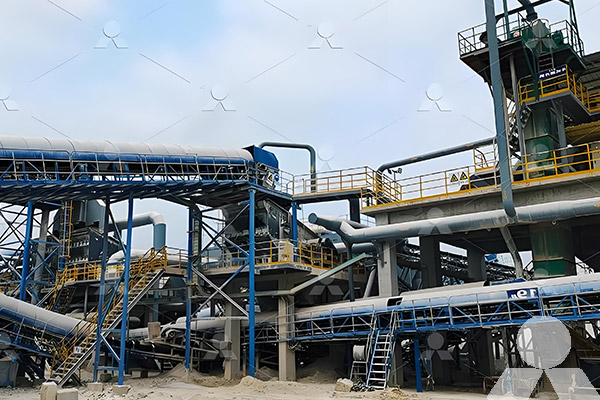
200-300 TPH Basalt Crushing Plant for G5 Standard Road Base in Liberia
Achieving a California Bearing Ratio of 80% for West African road construction demands rigorous control over fine particle distribution. This diagnostic report outlines the integration of C6X primary jaw units with HST secondary cone crushers to process Mohs 6-7 basalt. By stabilizing the discharge settings, operations can lower the plasticity index of 0.075mm fractions while optimizing the expenditure per shift during Liberia's challenging rainy season.
Tracking material flow during recent highway audits in West Africa reveals a critical failure point: contractors hemorrhage capital when their aggregates fail the California Bearing Ratio (CBR) tests due to uncontrolled fines. Processing Mohs 6-7 basalt in Liberia requires an architectural approach to crushing that aggressively shapes the stone while manipulating the final mixture gradient. The sticky industrial paste generated during the extended monsoon season easily blinds standard screening meshes, pushing the plasticity index (PI) beyond acceptable limits. Relying on outdated, single-stage configurations guarantees rejected stockpiles. Producing compliant G5 base material demands synchronized mass flow dynamics across a multi-stage closed circuit.
Arresting Plasticity Index Failures in West African Basalt
Controlling the 0.075mm passing fraction through specialized multi-stage compression directly lowers the plasticity index, ensuring the aggregate matrix achieves the strict CBR 80% requirement.
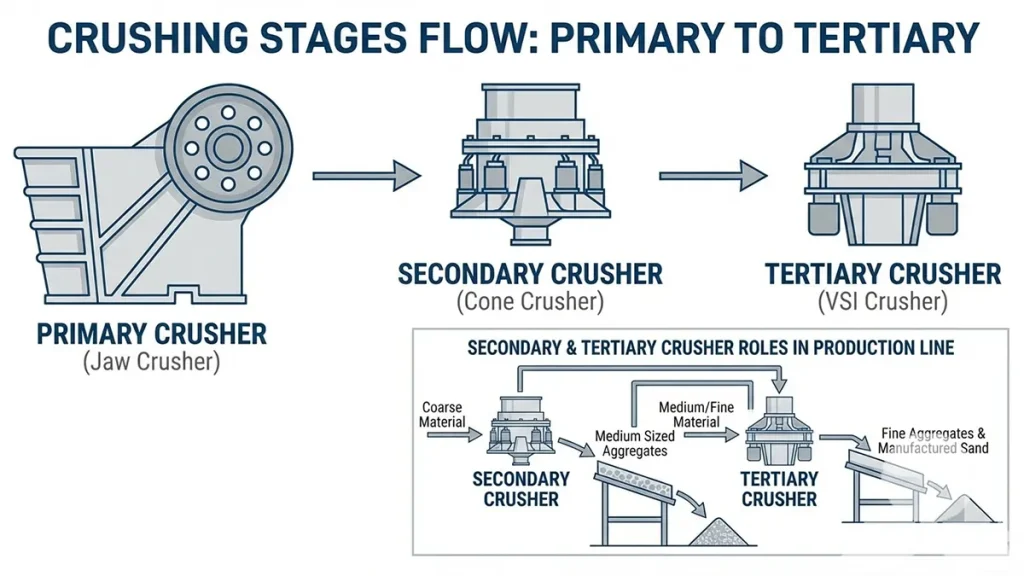
The engineering reality of constructing road bases in humid, tropical environments centers entirely on material behavior under compaction. When operating a high-capacity secondary cone crusher, the goal is not merely reducing rock size, but fracturing the crystalline structure of the basalt to eliminate elongation. High-silica basalt naturally resists initial cleavage. Pushing this material through inadequately powered used machinery results in heavy flakiness. Excessive flaky material acts as a wedge under compaction, trapping moisture and raising the plasticity index. Implementing a three-stage crushing and closed-circuit screening methodology forces the rock to undergo repeated, controlled collisions, rounding the aggregate edges.
Physics dictates that constant feed densities produce uniform grain shapes. By engineering the circuit to maintain a choke-fed cavity, the inter-particle attrition multiplies. This internal rock-on-rock friction naturally reduces the reliance on machine wear parts, extending the replacement cycle of wear parts significantly and improving the overall production sustainability.
Synchronizing C6X and HST Dynamics for Constant 35mm Feeding
Operating the HST250S single-cylinder unit at a constant discharge setting ensures the tertiary phase receives an uninterrupted flow of 35-50mm material, mathematically preventing downstream particle segregation.
To handle the abrasive nature of Liberian basalt at 300 tons per hour, we have engineered the following circuit configuration to balance operational expenses against raw output.
| Process Stage | Recommended Model | Capacity (tons per hour) | Power (kilowatts) | Output Size (millimeters) |
|---|---|---|---|---|
| Primary Compression | C6X110 Jaw Crusher | 160-550 | 160 | - |
| Secondary Shaping | HST250 Cone Crusher | 90-605 | 250 | 35-50 |
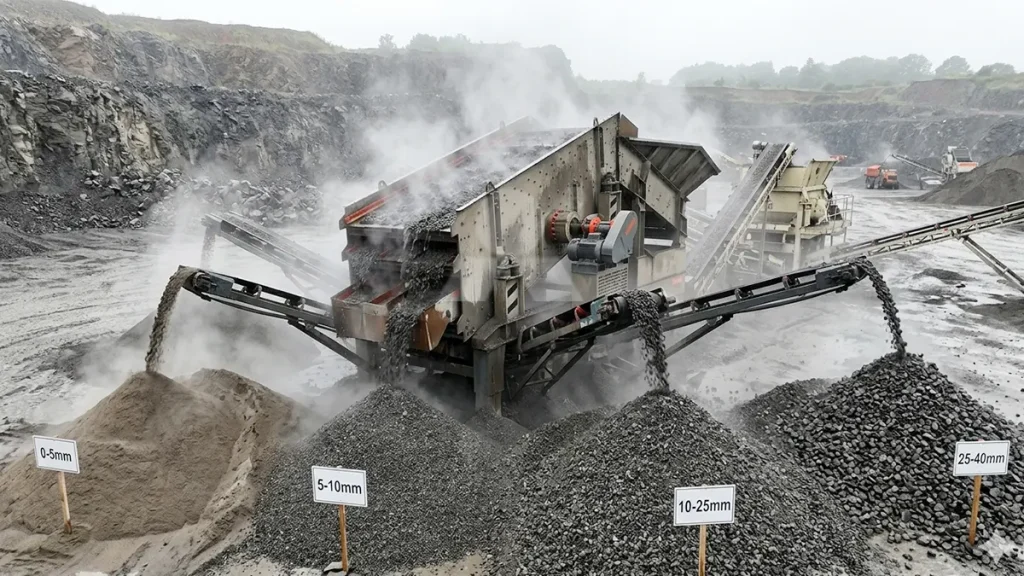
| Precision Grading | S5X1860-4 Vibrating Screen | 75-600 | 37 | 0-5, 5-10, 10-25, 25-40 |
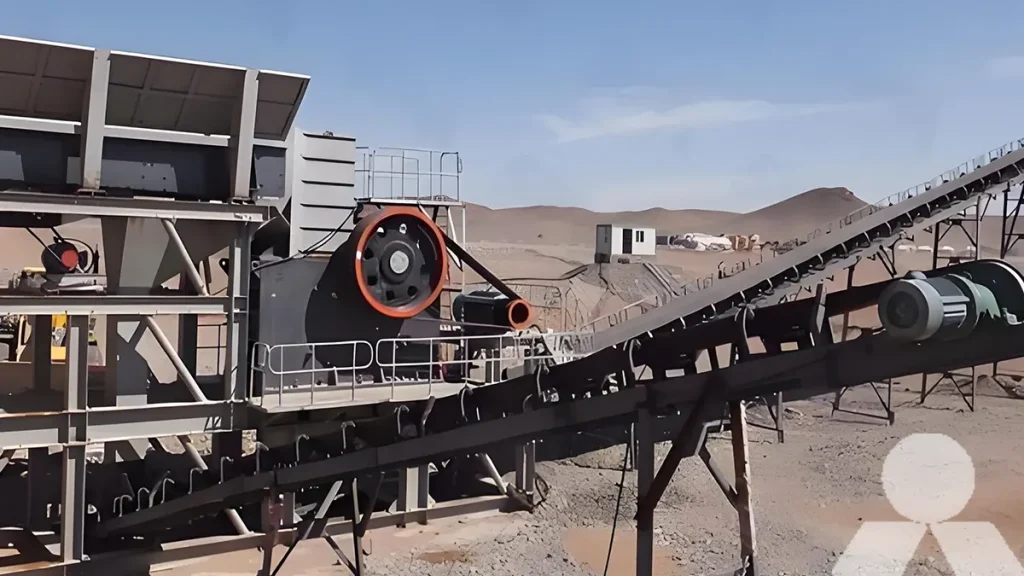
The initial compression stage relies on the C6X110 jaw crusher. Its heavy-duty eccentric shaft forces a deeper bite into the 720 millimeter maximum feed, neutralizing the initial rock hardness. The material then transitions to the HST250 hydraulic cone. We frequently encounter site managers attempting to bypass this critical synchronization. Pushing uneven loads into the secondary stage creates catastrophic spikes in amperage. The HST series mitigates this by utilizing a constant discharge setting logic, which locks the closed side setting under immense hydraulic pressure. The dynamic lock pressure on our A-grade units is exactly 15.8% higher than commonly sourced European secondary market machines. This specific engineering tolerance eliminates the "jumping" effect when the mantle encounters a particularly dense basalt vein, securing the continuous 35-50 millimeter feed flow into the final stage.

The Closed-Circuit Physics of G5 Specification Blending
Deploying four-deck separation technology allows for the targeted re-blending of fractions, resulting in a documented 12.5% increase in final aggregate matrix density.
To reach the CBR 80% bearing capacity, the process flow must integrate a highly responsive grading apparatus. The S5X1860-4 vibrating screen isolates the crushed basalt into precise dimensional bands: 0-5 millimeters, 5-10 millimeters, 10-25 millimeters, and 25-40 millimeters. By diverting exact percentages of these isolated stockpiles onto a multi-stage blending conveyor, the plant operator can manipulate the physical interlocking properties of the final mix. This volumetric control eliminates voids within the road base layer.
Monsoon conditions in Liberia introduce severe environmental friction. The tactile reality of wet, clay-bound fines bridging across a screen deck will halt a 300 tons per hour facility in minutes. To combat this, the Liming equipment configuration utilizes forced hydraulic lubrication and heavy-duty labyrinth dust seals. These defenses prevent contaminated water ingress into the main shaft assemblies. Protecting the internal bearings from microscopic silica scoring preserves the mechanical integrity of the entire plant, drastically reducing the required initial investment in backup capital components.
Field Wear Benchmarks: 250-Ton Basalt Material Balancing
- Primary Motor Load: 160 kilowatts
- Screening Power Draw: 37 kilowatts
- Constant Feed Target: 35-50 millimeters
- Secondary Power: 250 kilowatts
- System Output Yield: 75-600 tons per hour
- Maximum Raw Input: 720 millimeters
Technical Index: LH-200-300 TPH BASALT CRUSHING PLANT FOR G5 STANDARD ROAD BASE IN LIBERIA-April/2026-Ref-#83912
Architectural Log: Defeating Material Segregation in High-Moisture Environments
- Why do our CBR values fluctuate despite maintaining a steady 300 tons per hour throughput?
- Analyzing the stockpile distribution reveals the flaw. Throughput volume does not equal structural quality. If your secondary cone fluctuates its discharge gap, you produce an inconsistent volume of 0.075 millimeter dust, fundamentally altering the plasticity index.
- How does the 15.8% higher lock pressure on the HST unit translate to daily operational expenses?
- Review the history of standard spring-release cones in West Africa. When processing 250 Megapascal rock, a lower lock pressure allows the bowl to float, passing oversized, flat stones that demand immediate re-crushing, doubling your electricity draw and manganese wear.
- Are labyrinth seals strictly necessary if we pause operations during peak monsoon storms?
- Ignore the ambient moisture at your own financial peril. The humidity alone in Liberia introduces microscopic atmospheric silica into cooling oil; without multi-layer labyrinth protection, your 250 kilowatt main shaft bearings will seize within 400 operational hours.
- Can we achieve the 12.5% density increase by simply mixing the stockpiles with loaders?
- The mathematics of volumetric grading deny this approach. Loader mixing creates severe material segregation. Only an engineered, synchronized four-deck blending conveyor system can homogeneously distribute the 5-10 millimeter and 10-25 millimeter fractions to pass Ministry of Transport inspections.
Enforcing G5 Density Compliance in Liberian Highway Projects
Failing to stabilize the secondary crushing phase against the relentless abrasion of Mohs 6-7 basalt will systematically destroy the gradation curve, inevitably triggering total rejection of the road base matrix by transport authorities. Securing the documented 12.5% increase in structural density requires absolute synchronization between the HST hydraulic cone's locked discharge setting and the S5X screen's automated blending architecture. If you permit used, low-pressure crushing units to float their settings under load during the next heavy production cycle, the resulting surge of flaky aggregates will artificially inflate your plasticity index, causing immediate foundation subsidence and forcing catastrophic rework penalties next month. Calibrate your mass flow circuits today.
Secure Your 300tph Infrastructure Viability
"Evaluate your current fine particle distribution metrics." — From the Desk of your Solution Architect

Chief Technical Consultant
15+ Years in Mineral Processing & Mining Machinery
Senior mechanical specialist at Liming Heavy Industry. Leading expert in large-scale crushing circuits and global quarry optimization. His technical insights have helped over 500+ global projects achieve higher efficiency.