Secondary and Tertiary Crushers Roles in the Production Line
This guide distinguishes between secondary (sizing) and tertiary (shaping/sand making) crushing. It details the equipment choice (Cone for hard rock, Impact for soft rock, VSI for fines) and includes a comparison table.
In any aggregate plant, the primary crusher is the brute force, but the real value is created later in the process. Are you suffering from high amounts of waste material (fines), poor particle shape (flaky/needle-like), or excessive wear costs? These issues often stem from a misunderstanding of the secondary and tertiary crushers roles in the production line. While the primary stage focuses on volume reduction, the subsequent stages focus on precision, quality, and profitability.
At Liming Heavy Industry, we understand that "one size fits all" does not apply to mining. Whether you are processing hard granite or soft limestone, selecting the correct equipment for secondary and tertiary stages is critical. This guide will break down the specific functions of these crushers and how they transform raw rock into high-value commercial aggregate.
Secondary Crushing: The Sizing Stage
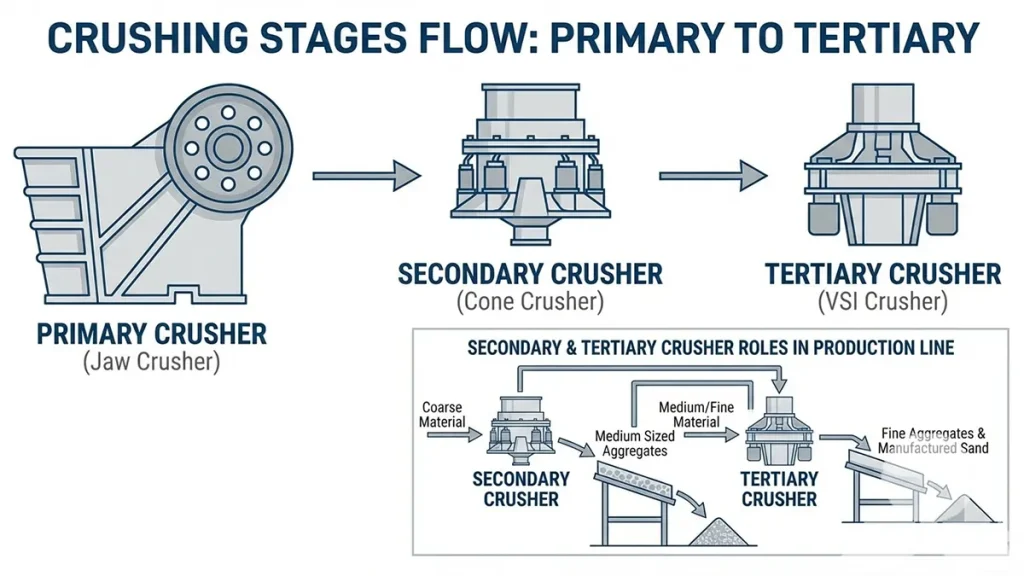
The secondary crushing stage follows immediately after the primary jaw crusher. Its main role is sizing—reducing the coarse 200mm+ stones into medium-sized aggregates (typically 20mm-60mm). This stage determines the throughput balance of the entire line.
Choosing the Right Secondary Crusher
The choice of equipment here is strictly dictated by the hardness and abrasiveness of the rock.
1. For Hard & Abrasive Rock (Granite, Basalt, River Pebble)
Recommended: Cone Crusher (HST/HPT Series)
- Mechanism: Uses compression force (lamination crushing).
- Benefit: Extremely durable against wear. Liming's HST Single Cylinder Hydraulic Cone Crusher offers automated control to maintain consistent output settings.
- Role: Efficiently reduces hard rock without incurring the massive wear costs that an impact crusher would face.
2. For Soft & Medium Rock (Limestone, Coal, Gypsum)
Recommended: Impact Crusher (PF/PFW Series)
- Mechanism: Uses impact force (blow bars hitting rock).
- Benefit: Produces a superior cubic shape naturally.
- Role: Reduces soft material quickly with a high reduction ratio, often eliminating the need for a tertiary stage in simple setups.
Tertiary Crushing: The Shaping and Sand Making Stage
When the market demands high-quality concrete aggregate (0-5mm, 5-10mm) or manufactured sand, the secondary and tertiary crushers roles in the production line become distinct. Tertiary crushing is about shaping and fine reduction.
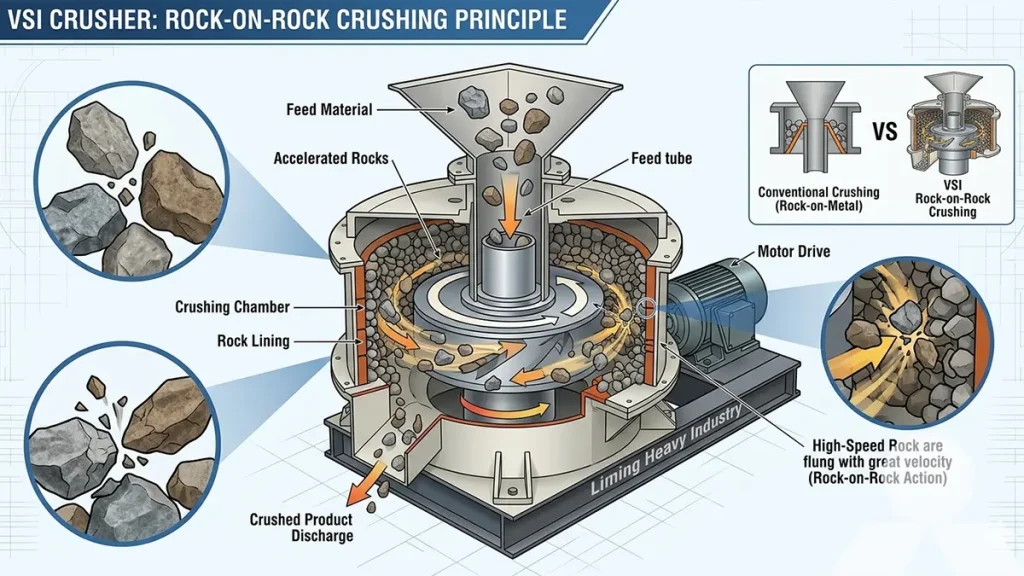
The Role of VSI (Vertical Shaft Impact) Crushers
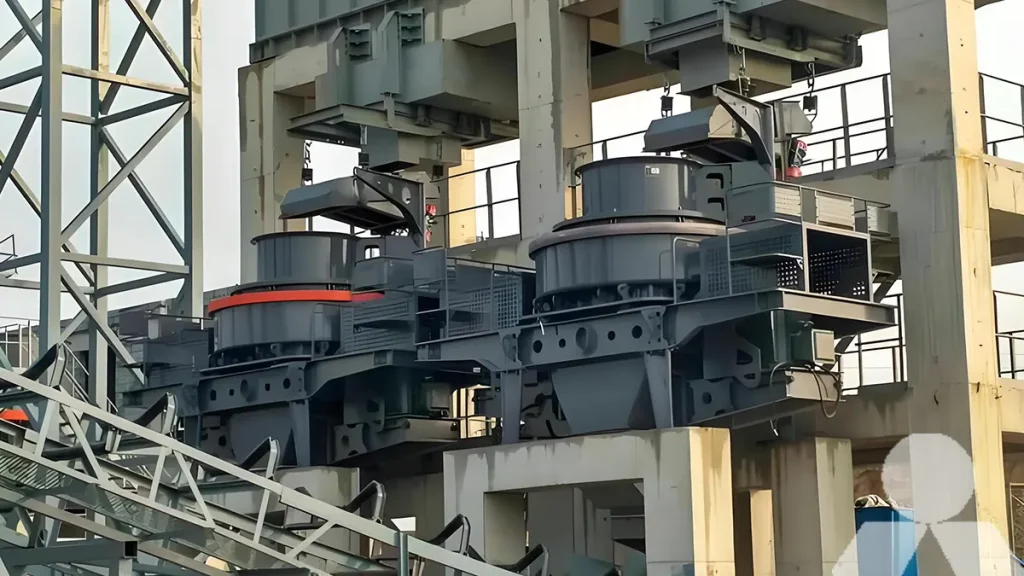
The VSI6X Series Sand Maker is the gold standard for this stage.
- "Stone-on-Stone" Principle: Material impacts against other material, not just metal. This significantly reduces wear costs.
- Shaping Function: It removes sharp edges from aggregates, creating a rounded, cubic shape that is essential for high-grade asphalt and concrete.
- Sand Production: It is the primary machine for converting chips and waste rock into valuable manufactured sand (M-Sand).
Comparing the Stages: Technical Breakdown
To summarize the differences, review the table below which highlights the specific secondary and tertiary crushers roles in the production line:
| Feature | Secondary Crushing Stage | Tertiary Crushing Stage |
|---|---|---|
| Primary Goal | Size Reduction (Coarse to Medium) | Shaping & Fine Reduction (Medium to Fine/Sand) |
| Input Size | Typically 100mm - 300mm | Typically < 50mm |
| Output Size | 20mm - 60mm | 0mm - 20mm (Sand & Chips) |
| Typical Equipment | Cone Crusher, Impact Crusher | VSI Crusher, Fine Jaw Crusher, Short-Head Cone |
| Key Liming Model | HPT Cone / PFW Impact | VSI6X Sand Maker |
Frequently Asked Questions (FAQ)
1. Can a Cone Crusher perform both secondary and tertiary roles?
Yes, to an extent. A standard head cone crusher is used for secondary crushing, while a "short-head" cone crusher is designed for tertiary fine crushing. However, for the best particle shape (cubicity), a VSI crusher is recommended for the final tertiary stage.
2. Why is tertiary crushing necessary for concrete aggregate?
Concrete requires aggregate with a cubic shape to ensure strength and save on cement paste. Secondary crushers (especially cones) may produce flaky needles. The tertiary stage reshapes these particles, ensuring they meet construction standards.
3. Does adding a tertiary crusher increase operating costs?
While it increases energy consumption, it often decreases total cost per ton by producing higher-value products (like M-sand) and reducing the load on the secondary crushers, extending their liner life.
Conclusion: Optimizing Your Line for Profit
Understanding the distinct secondary and tertiary crushers roles in the production line is the key to unlocking the full potential of your quarry. The secondary stage ensures efficient size reduction, while the tertiary stage guarantees the quality and shape that your customers demand.
Liming Heavy Industry offers a full range of HPT Cone Crushers, PFW Impact Crushers, and VSI6X Sand Makers designed to work in perfect synchronization.

Chief Technical Consultant
15+ Years in Mineral Processing & Mining Machinery
Senior mechanical specialist at Liming Heavy Industry. Leading expert in large-scale crushing circuits and global quarry optimization. His technical insights have helped over 500+ global projects achieve higher efficiency.